

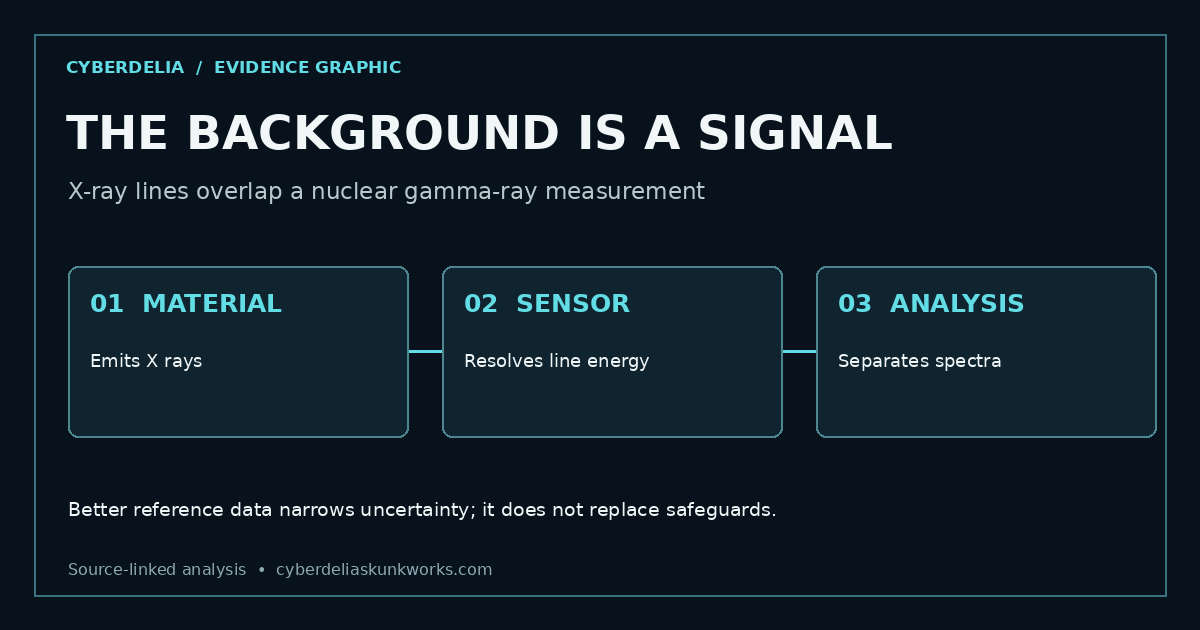
When an instrument is trying to identify nuclear material, the background is not always random noise that can be waved away. Sometimes it is another real signal from the material itself, sitting close enough to the line of interest that the instrument needs better reference data to tell them apart. That is the problem behind a September 2026 result from NIST and its collaborators: they used ultrasensitive quantum sensors to measure X-ray emissions from uranium, plutonium and neptunium with much tighter uncertainty than previous measurements.
The headline is easy to make grandiose. “Quantum sensor improves nuclear monitoring” sounds like a device that identifies anything through a wall. The actual mechanism is better and more precise. Nuclear accounting often relies on characteristic gamma-ray energies. X-rays from the same materials can occupy a similar energy range and complicate the interpretation. By measuring those interfering X-ray lines more accurately, researchers provide a better map of what a detector may be seeing.
What the sensor actually senses
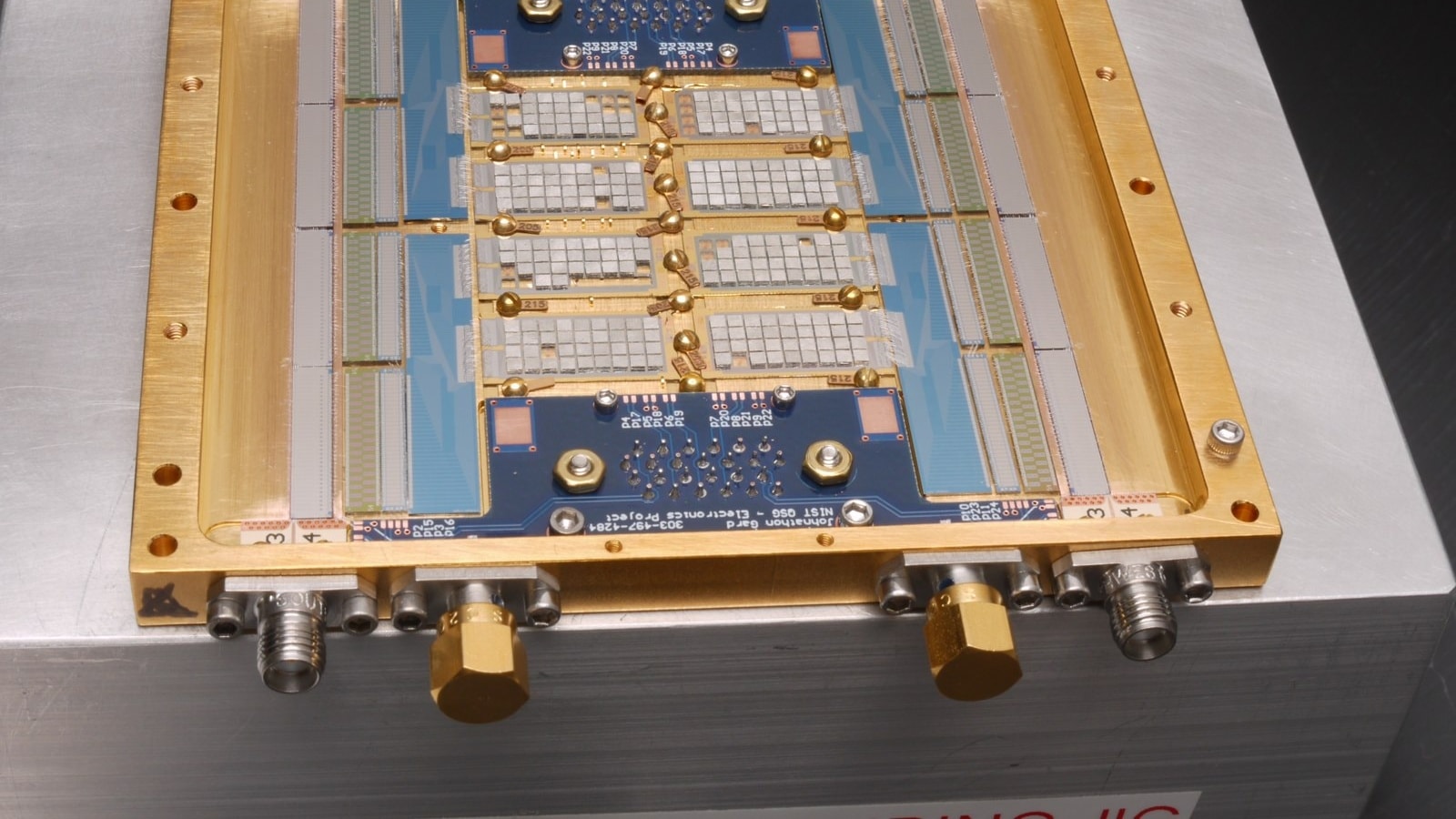
The device is a transition-edge sensor, or TES, operating close to the boundary where a superconducting film changes into an ordinary resistive state. A photon deposits a tiny amount of energy. That heating shifts the film's resistance, and the electrical response helps estimate the photon's energy. The design turns a very small temperature change into a measurable difference among nearby spectral lines.
NIST reports that the team used an array of these detectors to study X-ray emission in the region where it interferes with gamma-ray measurements. Its release says uncertainty in the relevant X-ray energy measurements fell to between one-third and one-eighth of earlier values. The linked paper reports the measured and theoretical line widths. That is a result about spectral reference information. It is not proof that every inspection system is suddenly three to eight times better at identifying material.
Think of the problem as reading two thin pencil marks placed almost on top of each other. A blurry instrument or uncertain reference table can make the marks look like one fat line. The TES helps characterize one contributor with more precision, so a later analyst has a better chance of separating a real isotope signature from nearby emissions. The useful number is the remaining uncertainty in the measurement, not the number of times the word “quantum” appears in a press release.
Why that matters beyond the laboratory
Isotopes of the same element have different numbers of neutrons, and their relative abundance can matter enormously. Nuclear fuel accounting, materials control and safeguards depend on knowing what is present and in what proportions. A gamma spectrum is one piece of that accounting. Cleaner background information helps analysts fit and interpret it with less ambiguity. NIST says the work can support faster composition assessments during fuel processing, potentially reducing delays between steps at a power plant.
Potentially is doing real work in that sentence. The new result measures spectral lines; the promised efficiency gain is a downstream use case. It requires suitable instruments, workflows, calibration and decisions at particular facilities. The laboratory measurement makes that path more plausible. It does not, by itself, document a power plant already saving a known number of hours or dollars.
Nor is this a pocket Geiger counter with a science-fiction upgrade. TES arrays need refrigeration to a fraction of a degree above absolute zero. NIST says systems have been installed at three Department of Energy laboratories and can be used where enough electrical power supports the refrigeration equipment. Samples can also be brought to a suitable lab. The cold hardware is part of the capability and part of its operating cost.
What would make the downstream claim stronger
To test the practical payoff, a safeguards team could process the same well-characterized mixed samples through an existing analysis pipeline and one using the improved X-ray reference measurements. It would report how the inferred isotope ratios and confidence intervals change, whether analysts reach different decisions, and how much extra instrument time or refrigeration capacity is required. That comparison would connect the laboratory precision result to an operational outcome. It would also reveal where another source of uncertainty dominates and further improvement in these lines produces diminishing returns.
The distinction matters because “higher resolution” is not a single system metric. A spectral line can be measured more accurately while a sample remains difficult to assay because its geometry, shielding, mixture, detector calibration or counting time limits the result. NIST's release is candid about the need for cold equipment; its mention of possible faster assessments is a credible application, but a facility-wide speed claim needs a facility-wide test. The serious version of excitement names the next measurement.
There is a second practical benefit to publishing reference work. Other laboratories can challenge the line shapes and energies against their own apparatus. Agreement across instruments strengthens confidence that an apparently faint gamma feature is a material signature rather than a fitting artifact. Disagreement is useful too: it sends engineers back to calibration, sample preparation or the model used to separate overlapping emissions.
A better distinction, not a magic detector
The interesting engineering lesson is that instrument progress can occur upstream of an obvious field deployment. A team can improve the reference spectra, the calibration and the way overlapping lines are modeled before it changes the box an inspector carries. Such work does not produce the clean drama of a new surveillance gadget. It does determine whether a later claim about material composition rests on a resolved signal or on a blurry fit.
There are still questions the public material does not settle: how this specific reference improvement propagates through different detector designs; how it performs against complex mixed samples; and what time or cost savings appear in routine operations. These are tests for deployment, not reasons to dismiss the measurement. The paper's contribution is narrower and more durable: it makes an interfering signal less mysterious.
In careful measurement, “background” should not mean “thing we did not bother to understand.” Here, the background had its own structure. NIST measured it more closely. That is how one begins to make a consequential signal legible.
More precise background references can improve the interpretation of gamma-ray spectra used in nuclear accounting. A lab measurement alone does not establish the field performance of every deployed monitor.