
DTEC's chief executive told Reuters on October 27 that Malaysia had authorized research exports of rare-earth material to the United States. The quantity is small compared with the requirements of a mature global supply chain. The engineering implications are considerably larger.
A shipment is not a supply chain
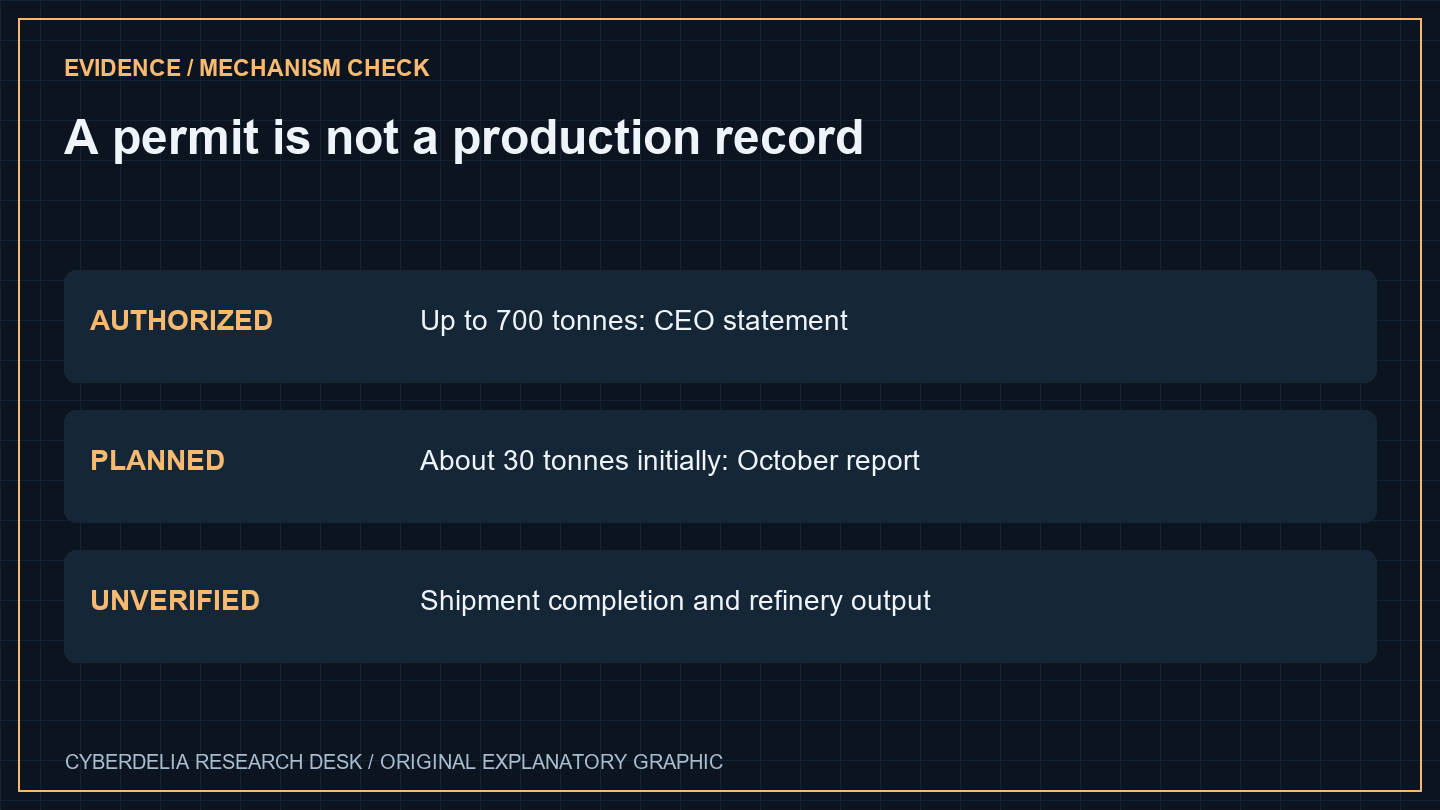
Somewhere beneath the soil in Malaysia's Perak state lies material that could eventually become part of an electric motor, industrial robot, advanced communications system, or other technology that depends on specialized magnetic materials. But there is an inconvenient problem between finding those minerals and manufacturing useful products from them. The elements have to be separated. That is far more complicated than it sounds. On October 27, Reuters reported that DTEC Mineral and Metal Technology, a Malaysian-registered company with majority American ownership, had received authorization to export up to 700 metric tons of rare-earth carbonate to the United States for research purposes.
According to chief executive Milan Perlly, an initial shipment of approximately 30 metric tons was expected that weekend; this review does not establish whether it subsequently shipped. The company intends for American researchers and industrial partners to evaluate separation and refining methods suitable for rare-earth materials extracted from Malaysian ionic-clay deposits. This is not evidence that a new industrial-scale rare-earth refinery has begun commercial production. It is evidence of something earlier and potentially more important in the industrial development process: testing whether the available material can be processed economically, reliably, and at acceptable environmental cost.
The distinction matters because the rare-earth supply chain is not one industry. It is several difficult industries connected together.
Rare earths are not necessarily rare
The term rare earth is one of the more misleading labels in modern technology. The group generally includes the fifteen lanthanide elements, along with scandium and yttrium. Some are relatively abundant in Earth's crust. Their economic scarcity often arises from concentrations, mineral associations, extraction difficulties, separation requirements, and the cost of processing them into usable forms. A deposit can contain large quantities of rare-earth elements without being commercially attractive. The material may be too dilute. The useful elements may occur in proportions that do not match industrial demand.
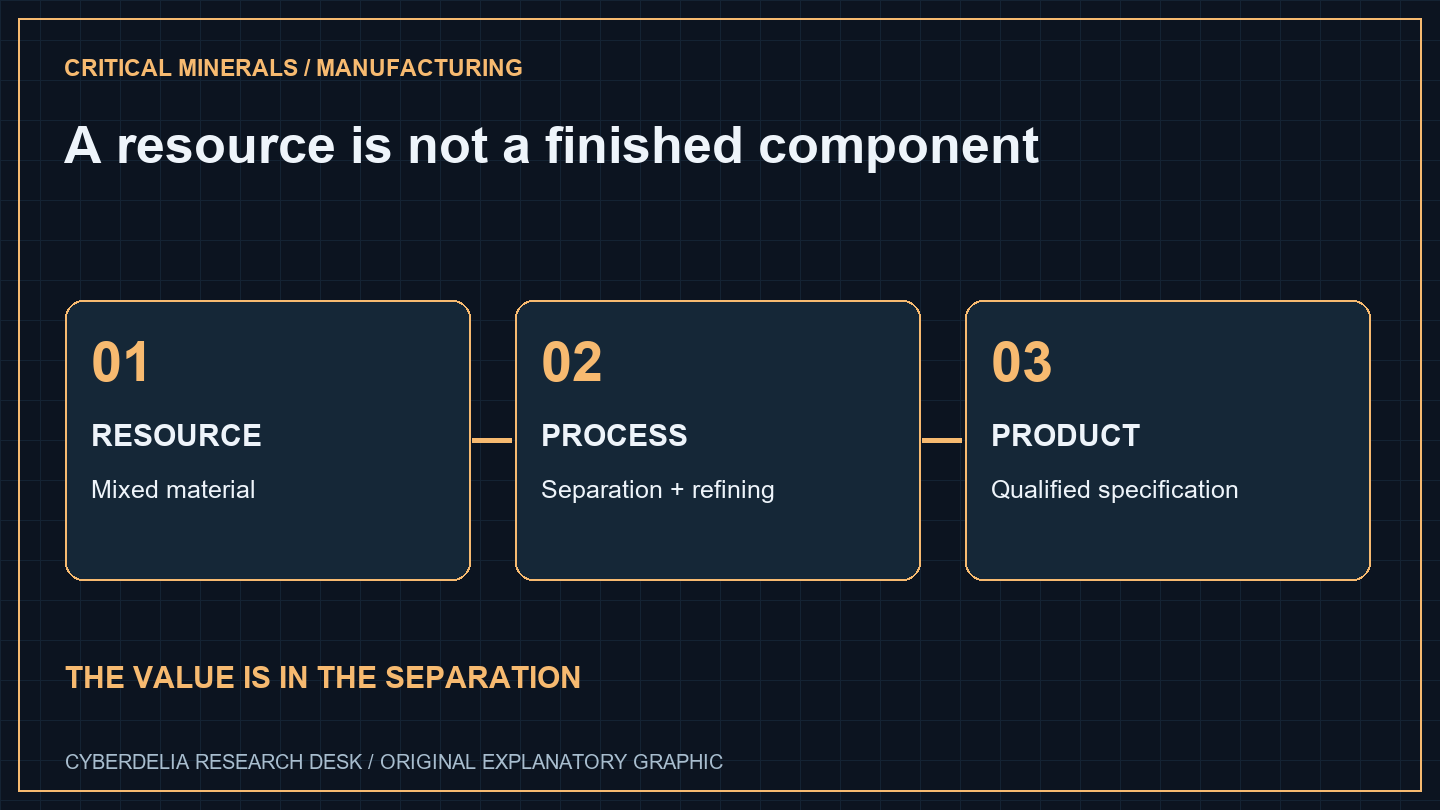
The minerals may require aggressive chemical processing. A project may have inadequate infrastructure, limited water availability, complicated environmental obligations, or no cost-effective refining route. Even after extraction, a concentrate containing multiple rare-earth elements is not the same thing as a product ready for manufacturing permanent magnets. One must separate the different elements, remove impurities, convert materials into appropriate chemical forms, and eventually produce metals or alloys to demanding specifications. This is why announcing millions of tons of estimated rare-earth resources does not automatically create millions of tons of commercially usable material.
The resource estimate describes the ground. The supply chain depends on what industry can accomplish after digging into it.
Malaysia's opportunity lies in the chemistry
Malaysia's rare-earth potential includes ionic-clay deposits. Such deposits are particularly interesting because they may contain valuable heavy rare-earth elements, depending on their composition. These materials can differ substantially from hard-rock rare-earth ores. In ionic clays, portions of the rare-earth content may be associated with clay surfaces through chemical interactions. Suitable leaching chemistry can potentially recover some of those elements without processing the deposit in exactly the same manner as a conventional hard-rock mine. That does not make extraction automatically easy or environmentally harmless. Recovery depends on local geology, mineral composition, reagent selection, liquid movement, process control, and downstream purification.
The initial solution may contain rare-earth elements together with unwanted dissolved materials. Those components have to be separated. The chemical engineering problem quickly becomes one of selectivity. How can a process recover the valuable elements while minimizing the extraction of unwanted materials? How much reagent is consumed per kilogram of recovered product? How much water is required? Can processing liquids be recycled? What waste streams are generated? What happens when laboratory conditions are replaced with variable material from an operating mine? These questions determine whether a promising deposit becomes an industrial resource or an expensive environmental liability.
The hardest part may begin after extraction
Rare-earth elements have chemically similar characteristics, particularly across the lanthanide series. That similarity is one reason separating them is difficult. Conventional industrial processing may rely on combinations of precipitation, ion exchange, solvent extraction, and other chemical operations. Solvent-extraction systems can involve repeated contact between aqueous solutions and an organic phase containing carefully selected extractants. Individual elements distribute between phases according to chemical conditions and their affinities for the extractants. Because neighboring rare-earth elements behave similarly, achieving very high purity can require repeated separation stages and tightly controlled operations.
A successful laboratory experiment may establish that one method can separate a particular pair or group of elements. A commercially useful process has to maintain acceptable recovery and purity across sustained operation. It must also account for reagent degradation, equipment corrosion, feedstock variability, water treatment, waste handling, labor, and maintenance. The difference is comparable to separating two nearly identical chemical compounds once on a laboratory bench versus operating an entire factory that produces thousands of kilograms at consistent quality. The second problem includes the first.
It also includes everything that can go wrong around it.
Why the research shipment matters
The October report of Malaysian export authorization provides an opportunity to study actual material from the deposits rather than relying entirely on generalized process assumptions. DTEC's chief executive says the material will be used by American companies and research institutions evaluating separation and refining technologies. The authorized maximum is 700 metric tons, while the proposed first shipment is much smaller. An authorized quantity is not a completed shipment. A completed shipment would not, by itself, establish that the receiving laboratories have developed a commercially viable process.
And even a successful laboratory process would not guarantee a profitable manufacturing facility. These distinctions are essential to evaluating the announcement. The immediate value lies in technical characterization. Researchers can determine the distribution of rare-earth elements, investigate impurity profiles, evaluate leaching behavior, compare separation methods, and estimate recovery under controlled conditions. They can also assess the composition and treatment requirements of process waste. A well-designed program would use multiple samples representing variability across the deposit. A single unusually favorable sample could produce impressive laboratory results while giving a misleading impression of the broader resource.
The goal should be to understand the full range of material likely to enter an eventual processing plant.
From kilograms to thousands of tons
Scaling chemical processes can reveal problems invisible in small experiments. A reaction that works in a laboratory vessel may behave differently in industrial equipment because mixing, temperature control, residence time, liquid distribution, and material handling become more complicated. Small-scale success often assumes carefully prepared feedstock. Industrial facilities must handle material arriving with fluctuating composition, moisture, and impurities. They must also operate continuously or near-continuously while controlling costs. A serious pilot plant should therefore report more than a single recovery percentage. Cyberdelia would want to see the mass balance.
For each quantity of material entering the plant, how much of each targeted element is recovered? What fraction ends up in waste streams? How much chemical reagent is consumed? What is the water balance? What purity is achieved? How much energy is required? And how consistently are those results maintained over extended operation? The best technical reporting would follow material through the entire process rather than focusing on one attractive laboratory measurement. A high recovery rate is not enough if the product is contaminated. High purity may not be economical if the process loses most of the valuable material.
Low reagent consumption may not compensate for very expensive equipment or unacceptable waste-management costs. Commercial viability emerges from the whole process.
Malaysia wants more than an export business
The economics behind the research program are also significant. Malaysia has an interest in developing domestic technical capability instead of becoming merely another location that exports raw or partially processed material. Its government imposed restrictions on raw rare-earth exports in 2024 and has since introduced conditional arrangements permitting certain research and processing-related shipments. That creates a strategic tension. Exporting material can enable foreign laboratories to develop technologies that Malaysia does not yet possess. But if the resulting intellectual property, technical expertise, and manufacturing capacity remain entirely overseas, the producing country may capture only a limited portion of the industrial value.
DTEC says it wants to build a processing facility in Malaysia within three years. Its chief executive also reported potential financing support of up to $650 million from the Export-Import Bank of the United States. That reported expression of support should not be treated as a finalized financing commitment or proof that construction will proceed. The commercially meaningful milestones are more concrete: independently validated process technology, financing agreements, permits, engineering contracts, equipment procurement, facility construction, commissioning, and actual product qualification. Those steps matter considerably more than a projected opening date.
A mine cannot manufacture a magnet by itself
Rare-earth materials are important to several modern industries, but the path from chemical concentrate to finished components includes additional manufacturing stages. High-performance permanent magnets, for example, require appropriately refined feedstocks, controlled alloy compositions, powder processing, forming, sintering or other fabrication methods, coatings, and rigorous quality control. Not every rare-earth element has the same role. Industrial demand differs dramatically between elements used in large quantities and those required in smaller amounts to achieve specialized magnetic or thermal properties. Consequently, increasing total rare-earth production does not necessarily solve shortages of the particular elements required by a given manufacturer.
An industrial strategy built around rare-earth security should therefore identify the specific material specifications its customers require. Which elements are present? Which customers can use them? What level of purity is needed? Can domestic or regional manufacturers convert those materials into finished industrial products? Does production remain economical when market prices fluctuate? Without answers, a resource-development project risks becoming a collection of impressive statistics disconnected from real manufacturing demand.
The environmental question cannot be postponed
Rare-earth processing has generated environmental controversy in several countries, including Malaysia. The concerns vary by deposit and technology, but can involve chemical waste, water contamination, land disturbance, and potentially radioactive constituents associated with some mineral sources. It would be inaccurate to assume that every ionic-clay project produces the same waste profile as every hard-rock rare-earth operation. It would be equally inaccurate to assume that a new chemical process is environmentally benign simply because its promoters describe it as cleaner. The evidence must come from site-specific measurements and independently reviewable operating data.
A strong development program should identify the elements and contaminants present in the feedstock, test the behavior of residues, evaluate containment requirements, and publish credible plans for long-term monitoring. Water treatment and chemical management are not peripheral public-relations issues. They are part of the plant's engineering. A process that looks inexpensive while ignoring these requirements may simply be transferring costs to nearby communities and future generations. The economically meaningful cost of production includes responsible waste management.
The tests that would justify confidence
Cyberdelia would evaluate Malaysia's proposed rare-earth processing development through a series of evidence gates. The first is deposit characterization. Publish representative sampling methods and elemental distributions, including the concentration of economically important rare earths and relevant impurities. The second is laboratory process validation. Compare recovery, purity, reagent use, waste generation, and energy consumption under reproducible conditions. The third is pilot-scale operation. Run the process for a sustained period using variable feedstock and document changes in performance. The fourth is an independent environmental assessment. Evaluate liquid and solid residues, containment, monitoring, and plausible failure scenarios.
The fifth is commercial qualification. Obtain evidence that real industrial customers can use the resulting separated materials and that the costs remain competitive when full operating expenses are included. Finally, disclose the transition from proposed investment to actual construction. A permit is an authorization. A shipment is a logistics event. A pilot experiment is a technical test. A working refinery is an industrial achievement. Those should never be confused.
The real strategic resource is industrial knowledge
The October 27 announcement concerns a relatively modest research movement of material. Its importance lies in the possibility of developing process knowledge that could eventually support a more diverse rare-earth supply chain. But international competition over critical minerals is frequently described as a contest to control deposits. That description is incomplete. The real industrial advantages include separation chemistry, process design, skilled operators, reliable equipment, waste-treatment systems, quality assurance, and the ability to deliver consistent materials to manufacturers. Those capabilities cannot simply be discovered underground. They must be developed.
Malaysia's opportunity is therefore larger than extracting more material from its soil. It is the possibility of converting geological resources into domestic industrial expertise. Whether this particular initiative accomplishes that remains unknown. The reported authorization has not established commercial success. The proposed refinery has not demonstrated production. The reported financing remains conditional. But the research program illustrates exactly where the next bottleneck lies. The rare-earth problem is not simply finding the dirt. It is learning how to turn that dirt into materials the world can actually use.
Source trail
- Reuters, DTEC export permit, October 27 (Kitco syndication)
- U.S. Department of Energy, Critical Materials Strategy
- U.S. Department of Energy, Rare Earth Permanent Magnets Supply Chain Assessment
Corrections and updates
Published November 13, 2026. Send specific corrections and supporting evidence through our corrections page. Material revisions will be recorded here.