

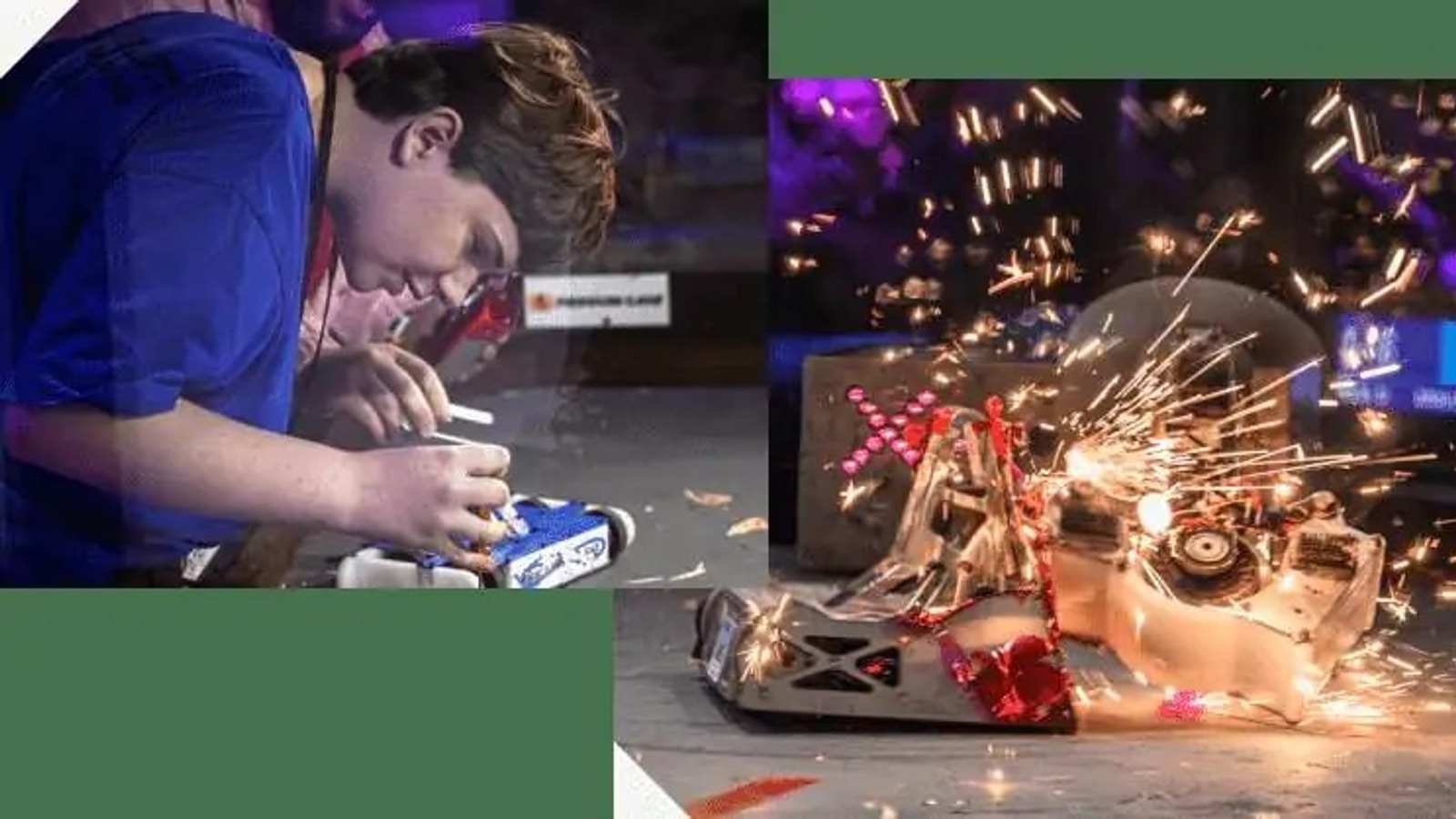
The robot gets up. The audience roars. In human boxing, standing after a knockdown is only the beginning of the referee's decision. In robot boxing, it may be the beginning of a much stranger problem: the machine can still stand while its sensors are wrong, a joint is overheating, a battery pack has taken a hit, and the controller is one bad estimate away from sending thirty-odd kilograms into a ringside technician. A recovery routine is not a medical clearance.
Robot combat already knows that safety belongs in the rules, not in a motivational speech. NHRL's public basics require a weapon lock outside the cage, an accessible way to cut power without disassembly and a radio fail-safe test. Its fights take place in an enclosure; machines can be knocked out, tap out, or go to a judges' decision after three minutes. Those rules address a world where a small custom robot may carry a dangerous spinning weapon. A humanoid boxer does not become harmless because it lacks a blade.
A biped can fall through a much larger physical envelope than a low-slung wedge. It can kick or swing while trying to regain balance. An arm can project through a gap during a scripted recovery. A miscalibrated estimate of foot contact can make the controller accelerate into empty space. The risk to people depends on mass, speed, reach, venue layout and separation, not on whether the move looks like boxing. The ring has to be engineered around the body that is actually there.
The harder case arrives between rounds. A robot can pass a pre-fight inspection and change state after one bad landing. An actuator can remain electrically alive while its gearbox has taken damage. A loose connector can produce intermittent sensor readings. A battery can keep delivering power while a cell or enclosure has been stressed. The machine may still perform the familiar get-up motion; the controller's success at one task can hide its loss of margin for the next.
That is why a corner should record condition, not just appearance. After a fall or sustained contact, a useful check would compare motor temperatures and current against baseline, inspect joint-position disagreement and fault logs, confirm battery voltage and pack integrity, review sensor health, and test whether the robot can take a controlled step without assistance. None of those readings proves safety alone. Together they tell the technicians whether this is the same machine that entered the previous round.
The team also needs to know what changed in software. If a controller automatically compensates for a damaged joint, the fighter may look surprisingly resilient while drawing more current from another actuator and shifting load to another limb. That adaptation is technically impressive and potentially hazardous. A return-to-fight decision should ask whether the compensation remains inside measured limits, not whether the robot managed to stay upright for one photogenic second.
A conventional boxing corner can see fatigue and swelling. A robot corner can see timestamps. That advantage is wasted if the log cannot be aligned with the bout. Each contact, fall, remote intervention, motor fault and emergency stop should map to the round clock and the broadcast frame. The resulting record does not require a proprietary source-code dump. It can show enough to explain whether the machine was stopped for contact damage, depleted power, a lost link, a controller anomaly or a referee decision.
To make that possible, leagues should define three distinct commands. A pause halts combat behavior while preserving controlled balance. A safe pose moves the machine into a known low-energy state if it can still do so reliably. An emergency stop removes hazardous drive power when continued motion is the greater danger. Calling all three a “kill switch” blurs the very decision an operator must make under pressure. The safe option after an unstable fall may differ from the safe option during a clean standing exchange.
The remote link has to be part of that design. NHRL demands a radio fail-safe test because a weapon that continues spinning after control is lost is unacceptable. A humanoid has a different response problem: cutting all power instantaneously can drop a tall machine onto whatever is next to it. Continuing the last command is no better. A league should test link-loss behavior with the actual platform and its actual arena geometry, document the conditions under which controlled descent remains possible, and establish who can command an immediate stop.
Human separation matters even when the robot is nominally disabled. A crew member walking into the ring after a knockdown should be able to verify the state of actuators without trusting a colored light alone. A mechanical or electrical power isolation procedure, a second person's confirmation, and a clear boundary between live recovery attempts and human retrieval make the corner less glamorous and more competent. The same discipline applies to battery handling after impact. A dented pack should not be sent straight back to charging because the next match is on the schedule.
There is a sporting question inside these precautions. If one team replaces an actuator and another fights through a degraded joint, what counts as the same fighter? If a league supplies common bodies, it can standardize spares and inspections, which improves fairness. It can also accidentally conceal a shared defect. A failure in one standardized platform should trigger an inspection across the field. The competitive advantage of identical hardware comes with a common-mode risk that an open-builder league does not share in the same way.
Judges need a vocabulary for the stop. A knockout should not mean merely that a machine is physically unable to move. It might mean loss of controlled locomotion, repeated falls, failure to respond to a lawful referee command, an unsafe thermal state, a compromised power system or a disabled communications link. A technical stoppage can protect the event even when the robot could stagger through another sequence. A tap-out gives the team a way to withdraw without pretending the machine has suffered a human injury.
The thresholds must be chosen from measured platform behavior. A single arbitrary temperature number copied between actuators is not a rulebook. A meaningful limit takes account of the motor, gearing, duty cycle, sensor accuracy and ambient conditions, with inspection procedures the officials can repeat. A league should publish the categories of faults that force a stop, record when those categories are triggered, and allow appeals on evidence rather than on how brave a piece of hardware looked under the lights.
A fair rule also distinguishes what the audience sees from what the machine can safely do. A fall may look dramatic and leave the system healthy. A minor-looking shoulder collision may damage a joint encoder enough to corrupt every later estimate of arm position. Scoring alone cannot perform the safety check. Neither can a highlights editor. Good coverage should say when a stoppage is confirmed, when its cause is provisional and when a post-bout inspection changed the first account.
Teleoperation complicates the responsibility chain. The pilot can feel the fight through video and controls, but may not see a rising current trace. The software team can see the trace but may not feel the opponent closing range. The pit crew can inspect hardware only after the robot reaches them. The referee sees the body and crowd, not necessarily the internal fault state. Somebody must have final authority to stop motion; several people may need independent authority to request it. That division should be written before the first bell.
The strongest leagues will treat the corner as part of the sporting product. Show the audience a redacted condition summary between rounds: temperature band, battery state, detected faults, repairs, link status and whether the fighter passed its return check. Explain a technical stoppage with the same respect a racing broadcast gives to brake failure. That turns a disappointing interruption into information. It rewards teams that build machines that can be inspected, repaired and trusted repeatedly.
There is no evidence that every current humanoid league has solved this. It is unknown whether any specific league has adopted the exact stop protocol proposed here. Their published formats and demonstrations show the spectacle and some of the competitive architecture; the public still needs clear, platform-specific stop rules and post-contact records to judge durability. NHRL's established safety basics are a useful point of comparison, but a full-size biped is not a 30-pound spinner wearing a Halloween costume. The failure physics are different. The standard must be written for the machine in the ring.
A robot boxer should be allowed to get up after a punch. That is one of the great sights the sport can offer. The next question belongs to the corner: after it got up, did we verify what still works, what is damaged and what it will do if the next punch lands? A fighter that can continue is a technical claim. The log, the inspection and the stop rule are how the league earns it.
A standing robot is not automatically fit to fight. Leagues should publish platform-specific stop categories, test link loss and safe power states, log impacts and faults against the round clock, and make the return-to-fight check visible enough to trust.