
A robot that dances through an exhibition hall and a robot that successfully operates in a changing warehouse may look similar to a casual observer. Technically, they belong to different worlds. A dance can be choreographed, rehearsed, and performed in an engineered space. A useful service robot must handle the inconvenient universe: the carton that arrived crushed, the handle someone replaced, the object half-hidden behind another object, and the human who enters the work envelope at exactly the wrong moment.
That distinction matters because a spectacular robot demonstration is evidence of a narrow capability, not proof of general competence. The next important contest in physical artificial intelligence is not necessarily about which humanoid can execute the most impressive move. It is about which organizations can make machines see unfamiliar environments, understand geometry, estimate uncertainty, manipulate real objects, and recover after a mistake.
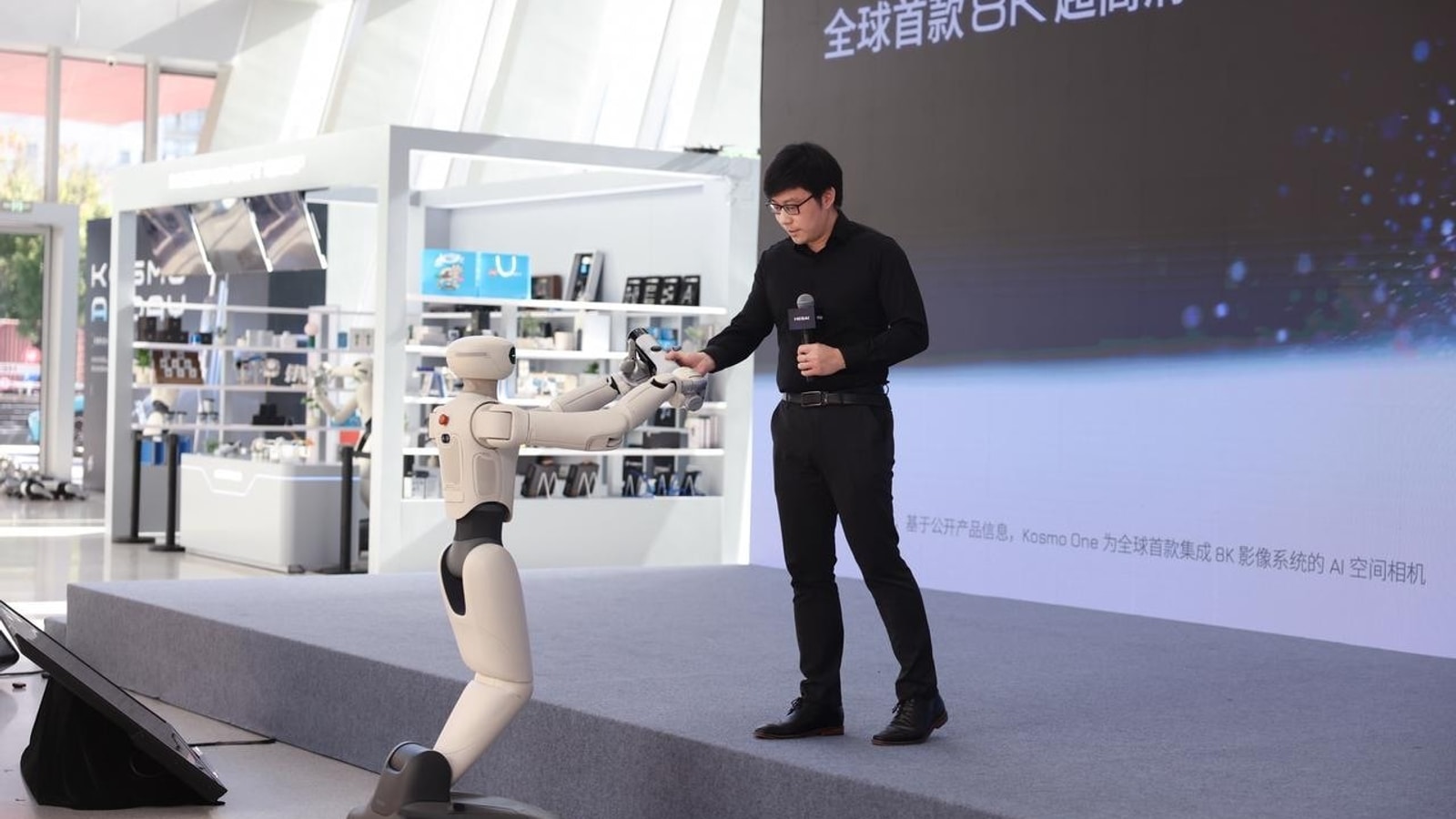
On October 14, Chinese lidar manufacturer Hesai announced Kosmo, a spatial-data system combining a dedicated imaging device, Kosmo One, with a cloud platform called Kosmo World. The company describes a system that turns observed physical settings into detailed three-dimensional digital environments for robotics training and related applications. Its announcement named collaborations with embodied-AI companies Galbot and Dexmal, alongside other demonstrations. Reporting by Reuters also noted Hesai's interest in compact precision actuators, the mechanisms that let robotic hands do more than open and close. These are company announcements and reported demonstrations, not independent proof that general-purpose robots have arrived.
The more interesting development is architectural. Hesai is positioning itself not simply as a component supplier but as part of the infrastructure through which robots acquire information about the world. That is a different commercial ambition from selling another sensor to another manufacturer.
The simulation-to-reality debt
Every robot begins with a mismatch between the environment in which it learns and the environment in which it must work. Simulation is attractive because it allows repetition, controlled experiments, and potentially large-scale data generation without putting people or equipment at risk. But a virtual table is not a physical table. Its friction may differ. Its surface may reflect light differently. Its edges may be imperfect. An object may bend, stick, or shift as the gripper closes.
This mismatch is sometimes called the simulation-to-reality gap. It becomes especially punishing in manipulation. A mobile robot can often navigate around an uncertain object. A gripper approaching a slippery cup cannot simply ignore the local contact physics. Small errors in a few millimeters of position, the strength of a grip, or the timing of release can convert a successful demonstration into a dropped object.
A richer map of a working environment helps but does not, by itself, solve the gap. Geometry tells a robot where surfaces appear to be. It does not automatically reveal mass, friction, fragility, deformability, hidden joints, or whether a person is about to move the object. Physical intelligence needs several layers working together: sensing, state estimation, planning, real-time control, tactile or force feedback, and mechanisms that can execute a plan reliably.
The value proposition for a spatial-data platform therefore depends on how well it connects those layers. If the platform produces visually convincing reconstructions but cannot supply the temporal, physical, and action-relevant information that a robot needs, its strongest applications may lie in visualization or simulation rather than autonomous manipulation. Conversely, if it allows developers to systematically capture difficult edge cases and replay them against robot policies, it could meaningfully shorten development cycles.
Why the sensor is part of the dataset
No sensor observes reality directly. A camera records light through optics and image processing. Lidar measures ranges from returned optical signals. Both involve calibration, resolution limits, occlusion, synchronization challenges, and choices about what to preserve or discard. A three-dimensional representation assembled from these instruments is an estimate of a scene, not the scene itself.
For robotic training, that distinction is operational. Consider a hand reaching for a reflective metal tool beside a transparent container. Ordinary camera images may supply useful appearance cues, but reflections and transparency can complicate geometric reconstruction. Range sensors can help recover distances in some conditions, while struggling with others. Combining multiple measurement sources can improve reliability, but only when their coordinate frames and timing are correctly aligned.
A practical evaluation should therefore ask what Kosmo captures, at what rate, with what spatial and temporal precision, and how calibration drift is detected. Does it represent objects consistently when lighting changes? Can it track moving hands and tools? Does the dataset preserve failure cases or quietly filter them out? A training system built only from beautifully reconstructed successes risks teaching machines an unrealistically tidy universe.
There is also a feedback problem. Developers often collect data from the robot behavior they already have. If a robot never attempts difficult grasps, its experience may contain too few difficult grasps to improve. A useful data engine should support targeted collection, annotation, replay, and tests that show whether a newly trained policy improves on specific failure classes rather than merely performing well on familiar scenes.
The other half of physical intelligence has fingers
Reuters reported that Hesai is also developing compact actuators, with its components used in advanced robotic-hand work. This deserves attention because perception and manipulation are not separate industries in practice. A superb model of an object has little value if the end effector lacks the precision, force sensing, durability, or compliance to interact with it.
Actuators translate a control decision into motion. Their performance involves tradeoffs among torque, speed, heat, size, power consumption, backlash, and cost. A robot hand with many degrees of freedom has to coordinate those tradeoffs repeatedly, sometimes thousands of times per shift. A delicate grip may need compliant contact and detailed feedback; lifting a bulky object may require the opposite mechanical emphasis.
This means the economic test is more demanding than a successful pickup. A commercially useful robot must succeed across the range of tasks it is being paid to perform, survive ordinary wear, be maintainable, and operate safely near people. A hand that can serve ice cream at a demonstration is interesting evidence of integration. It is not yet evidence of an economical food-service worker, let alone a universal platform.
One reported demonstration involving Sharpa Robotics achieved a high task success rate for autonomous ice-cream service. The unanswered questions are as important as the headline number. How many attempts were counted? What conditions changed between attempts? Did human operators intervene? Were failures retried? What counts as a successful serving? How does performance change with unfamiliar containers, changing lighting, or mechanical wear? Without those details, the result illustrates possibility, not generality.
China's real advantage may be the industrial loop
There is a familiar story in technology journalism: one company announces a robot, another company announces a more attractive robot, and the public is invited to imagine which will conquer the future. A more useful frame is to examine the industrial loop around them.
China has considerable manufacturing capacity in sensors, motors, batteries, electronics, machined assemblies, and industrial automation. When design, component procurement, prototype assembly, and production testing are geographically and commercially close, a company may be able to move through hardware revisions quickly. That does not guarantee superior research, dependable software, or customer adoption. It does mean the economics and speed of iteration deserve attention alongside model benchmarks.
Hesai's move from automotive lidar toward robot spatial-data infrastructure illustrates how one mature component category can become a bridge into another. Automotive systems demand reliable sensing under movement and varying conditions. Robots share some of that demand, but add close-range manipulation and more intimate contact with people and objects. Transferring expertise is plausible; assuming the automotive solution directly solves robotic dexterity is not.
The business question is whether customers will prefer tightly integrated stacks from a small set of vendors or interoperable layers that allow robots, datasets, simulators, and sensing systems to be swapped independently. Integrated products can be easier to deploy and optimize. Open interfaces can reduce lock-in and permit specialized teams to collaborate. In industrial settings, the latter issue matters when a machine is expected to remain in service much longer than a startup's current product cycle.
Privacy is not a side issue
If spatial-data capture becomes routine, the robot-development pipeline acquires another problem: what exactly are companies recording? Industrial facilities can contain proprietary layouts, protected equipment designs, sensitive inventory, and workers who have not consented to become part of a training dataset. Domestic environments raise still greater concerns.
A platform that reconstructs physical spaces for training may also preserve information that a conventional camera feed makes harder to search or reuse. Three-dimensional layouts, object relationships, movement patterns, and repeated observations can reveal habits or operational details. The question is not whether spatial data is inherently improper. It is whether collection, retention, access, licensing, and removal can be governed at the level demanded by the places where robots will operate.
For an enterprise buyer, useful questions include whether processing can occur on premises, who owns derived training records, whether a vendor can reuse captured scenes, and whether sensitive regions can be masked or deleted without corrupting the training pipeline. A claim of industrial readiness that ignores these questions is incomplete.
What we would test before buying the story
Cyberdelia's proposed benchmark is deliberately boring. Select a set of ordinary objects and environments not included in demonstrations. Change lighting, add clutter, vary object placement, introduce reflective and deformable surfaces, and measure both first-attempt success and recovery after failure. Repeat across days, operators, and equipment states. Report not only successes but time per task, intervention frequency, damage, energy consumed, calibration effort, and maintenance events.
A second test would separate perception from manipulation. Give competing robot systems the same task descriptions but vary only the scene representations. Does the additional spatial-data platform improve outcomes when the robotic hardware remains unchanged? Then hold the data fixed and vary end effectors. The results would reveal whether perception, grasp mechanics, or policy is the binding constraint for that task class.
A third test would measure generalization. A robot that succeeds after extensive site-specific training may still be economically valuable in a factory. But that is a different claim from a robot that arrives and works with minimal adaptation. The deployment cost, including setup labor and integration, belongs in the analysis.
At present, the publicly described release establishes that Hesai has announced a new spatial-data product and demonstrated partnerships. It does not establish that its system independently closes the simulation-to-reality gap, that its datasets are superior to alternatives under controlled testing, or that participating robots achieve broad task generality. Those remain open empirical questions.
The interesting future is the unglamorous one
The robotics industry is approaching a reckoning that is both technical and financial. Investors can fund another stage performance. Employers have to pay for uptime, throughput, safety, and dependable work. The companies that master uncelebrated infrastructure, calibration, fleet management, sensing, actuation, and failure recovery may capture more lasting value than the companies that produce the most circulated videos.
That is why the Kosmo announcement is worth covering beyond the product launch. It points toward a possible industry architecture in which physical-world data becomes a service layer and sensors become tools for continuously teaching machines how environments behave. It might accelerate progress. It might also expose how much knowledge is missing between a visually complete digital room and a robot that can safely work inside it.
The real milestone will not be when a robot dances better. It will be when it enters an unfamiliar, imperfect workplace, learns the job without demanding that every object be staged for it, and completes useful work long enough that nobody feels the need to film the performance.
Evidence and sources
- KNOWN / primary announcement: Hesai, “Building the Data Infrastructure for Physical AI: Hesai Launches Kosmo 3D World Data Engine,” October 14, 2026. https://www.hesaitech.com/9974-2/
- REPORTED / independent reporting: Reuters, “China's Hesai launches spatial camera to boost AI-powered robotics adoption,” October 14, 2026. https://www.reuters.com/technology/chinas-hesai-launches-spatial-camera-boost-ai-powered-robotics-adoption-2026-10-14/
- INFERRED / Cyberdelia analysis: The bottlenecks linking spatial sensing to robot reliability, procurement, and privacy are analytical implications, not performance claims made or established by the cited announcements.
- UNKNOWN: Independent benchmark results, full dataset methodology, licensing terms, broad task generalization, and life-cycle cost.
Corrections and updates: Dated corrections will be appended as new independent evidence becomes available.