

A mobile phone is an astonishingly successful disguise. It feels like a personal object. It fits in a pocket, and its interface suggests that communications begin and end with the person holding it. In reality, the device is the smallest visible part of a vast system of spectrum assignments, cellular infrastructure, fiber routes, interconnection agreements, identity services, roaming rules, and regulatory permission.
When somebody loses a signal in a remote valley or during an infrastructure outage, that system becomes suddenly visible through its absence. Satellite-to-phone connectivity promises to hide the absence again by placing another radio path overhead. Yet replacing a dead spot with a satellite connection is more complicated than extending a coverage map. The path through which a message reaches the network matters, because the entities controlling that path can influence availability, cost, compatibility, security, and resilience.
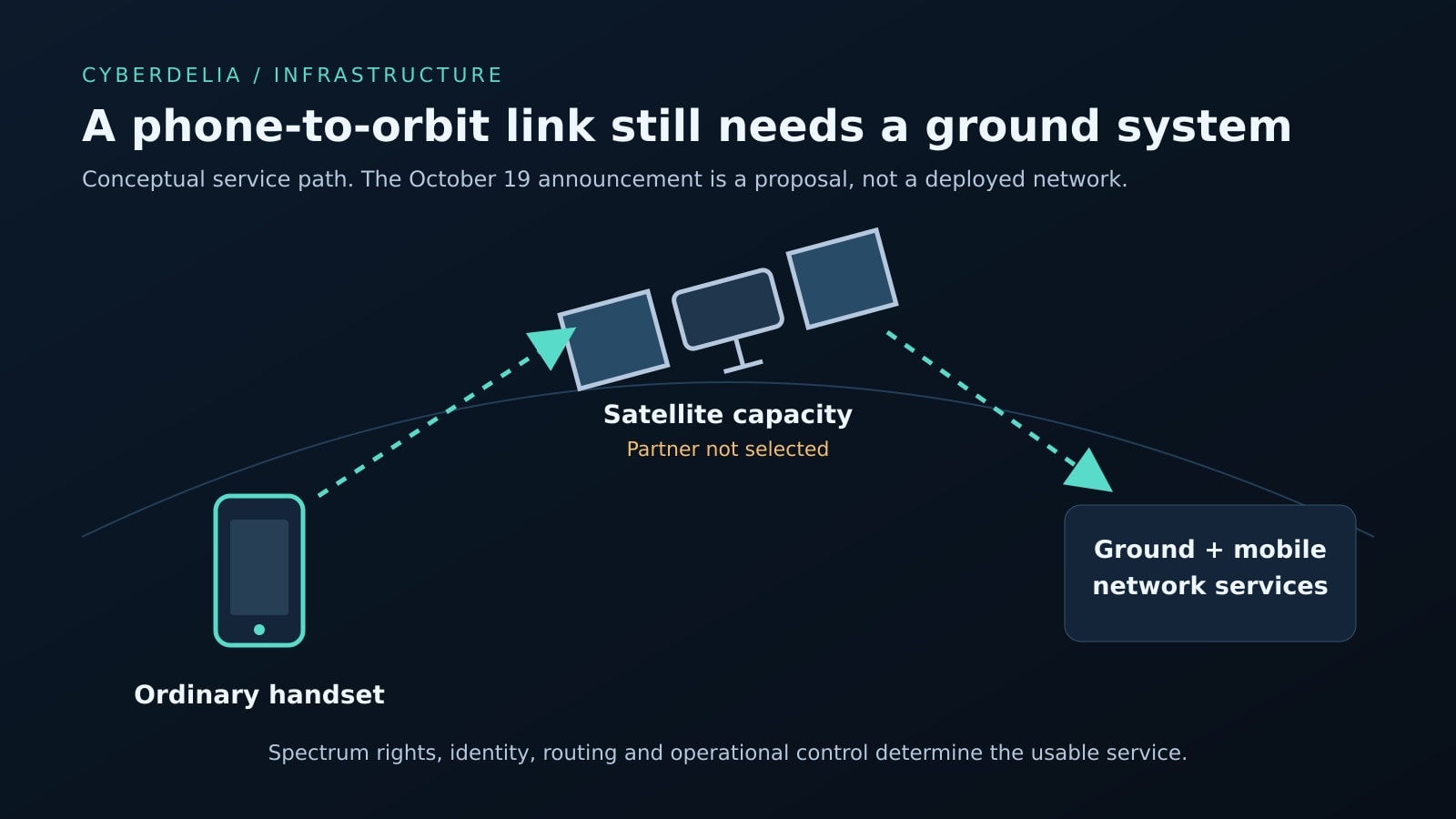
On October 19, Deutsche Telekom, Orange, Telefónica, and Vodafone announced a letter of intent to explore a joint bid for European Mobile Satellite Services spectrum. The four operators describe an ambition to provide open and nondiscriminatory access for European mobile providers offering direct-to-device services. They intend to establish key ground infrastructure and coordination functions in Europe, while relying on an as-yet-unselected satellite partner to provide the orbital constellation. The announcement explicitly says the exploratory plan does not replace their existing satellite partnerships.
That is the verified starting point. It is not an awarded spectrum license, not a selected satellite fleet, not a deployed service, and not evidence that consumer coverage has changed today. The story is what this proposed architecture reveals about the next era of connectivity.
The sky still needs a terrestrial network
A satellite network is frequently presented in the public imagination as an escape from terrestrial infrastructure. That is only partly true. A satellite can bypass a damaged tower or reach a location without conventional cellular coverage. But a practical communications service still needs spectrum rights, user authentication, service management, data routing, customer support, and mechanisms for exchanging information with networks on Earth.
Depending on the satellite system and service design, communication may pass through gateways, ground stations, inter-satellite links, operator cores, and other terrestrial components before it reaches the intended recipient. Satellite coverage can remove a particular dependency while retaining or introducing others. Treating the entire architecture as one magic emergency connection obscures the actual failure points.
The European operators' proposal is therefore notable for the division of responsibility it sketches. They propose to own or coordinate important ground-side functions and market access while contracting with a satellite partner for the constellation. That is a model of partnership rather than a fully vertically integrated satellite telecom company. The exact contracts will determine how much operational authority sits with the terrestrial operators and how much remains with the orbital provider.
This is not a pedantic distinction. If a ground control system experiences a failure, if the satellite partner changes service priorities, or if multiple operators contend for scarce capacity, users will discover which entity actually controls the connection. The difference between nominal access and enforceable operational rights becomes most important under stress.
Direct-to-device is not one thing
The phrase direct-to-device describes a family of approaches rather than a single guaranteed product experience. Some systems initially support limited messaging or emergency functions. More demanding services can involve voice and eventually broader data connectivity, depending on radio capability, spectrum, satellite architecture, link budget, and network integration.
A conventional cellular network can deploy towers with relatively close proximity to users and manage frequency reuse across many cells. A satellite link operates over much greater distances, works within tight power and antenna constraints, and must accommodate relative motion and broad geographic footprints. Even with sophisticated antennas and signal processing, the capacity available to a user may be far below that of a strong terrestrial 5G connection.
The engineering questions should therefore be explicit. Which devices and radio standards will work? Will ordinary handsets connect without specialized hardware? What service classes will be supported at launch? How many concurrent users can a coverage area sustain, particularly during an emergency? What happens when users move between terrestrial and satellite paths? Who controls priority when capacity is constrained?
None of those details is settled by the operators' letter of intent. A useful article should resist transforming the promise of direct-to-device coverage into an implied promise of satellite broadband everywhere.
Spectrum is infrastructure before hardware exists
The consortium is exploring a bid for spectrum that has yet to be allocated. That may sound bureaucratic, but radio spectrum is one of the defining inputs of wireless engineering. A satellite can be launched; it cannot legally and reliably deliver a service simply because its owner possesses a transmitter. Frequencies have to be coordinated to limit harmful interference and support predictable service among multiple users, operators, and jurisdictions.
In a crowded orbital and communications environment, spectrum is also commercial leverage. Whoever holds or controls the relevant rights can influence who enters a market, on what terms, and how competing networks coordinate. This is why the four operators' emphasis on open access matters: it is a governance proposition as much as a technical one.
A consortium arrangement could reduce fragmentation by providing a common entry point for multiple terrestrial mobile networks. It could make technical integration more consistent and avoid every operator developing a separate negotiating relationship for the same satellite capacity. But those are potential advantages, not guaranteed results. A common gatekeeper can also become a concentrated point of commercial leverage if the access rules are not transparent and enforceable.
An open-access promise must eventually be translated into measurable conditions: pricing structures, interoperability requirements, priority rules, dispute resolution, performance guarantees, and conditions for smaller operators. No independent assessment of those conditions is possible before detailed bid documents and commercial agreements are public.
What sovereignty can and cannot buy
The participating operators frame the initiative partly around European sovereignty, security, and resilience. Those terms are easy to use as political slogans; they are harder to specify as engineering requirements.
Operational sovereignty might mean that certain control functions and sensitive records remain within Europe, under European legal oversight. Supply-chain sovereignty might mean access to domestically manufactured or independently replaceable components. Commercial sovereignty might mean that European operators retain bargaining power rather than depending entirely on a single external provider. Security sovereignty might involve auditable control planes and incident-response authority.
These goals can overlap, but they are not interchangeable. A network with European ground operations and an external orbital provider is not autonomous in the same way as an end-to-end European-owned constellation. That does not make it a bad design. It does mean the design should be evaluated against the actual resilience and control it provides, rather than against a label.
The more honest question is which dependencies the arrangement reduces and which it deliberately retains. That is especially important when satellite connectivity is advertised as backup infrastructure for public safety, disaster response, transport, or critical communications.
The overlooked risks are at the boundaries
Security conversations often focus on encryption over the air. Encryption is essential, but connectivity security also depends on identities, key handling, ground-station protection, update practices, signaling integrity, operator interfaces, and lawful access procedures. A message may travel over a protected radio link while passing through management systems with entirely different risks.
Multi-operator satellite integration adds interfaces between organizations that may use different operational assumptions. Authentication handoffs and roaming arrangements need to work reliably. Monitoring systems need to distinguish a satellite outage from a terrestrial network fault. Customer-service teams need to identify failures even when they do not control every component in the chain. Cross-border privacy obligations have to be resolved by design rather than improvised after deployment.
The difficult scenario is not a sunny-day product demonstration. It is a major regional disruption in which power is limited, backhaul is damaged, emergency responders need priority, the number of users seeking satellite access rises dramatically, and support teams cannot depend on ordinary communication channels. That is where backup capacity and operational agreements can matter more than the nominal geographic footprint.
Cyberdelia would judge the claimed resilience of a future service against that scenario, not simply against a map shaded in a reassuring color.
A practical resilience test
Consider a municipality where a fiber cut and storm damage simultaneously impair several cell towers. Compare three arrangements: conventional terrestrial coverage alone; terrestrial coverage with a satellite fallback from one operator; and a shared satellite access system available through several participating mobile networks.
The test should measure the percentage of compatible devices that successfully attach to the backup path, the time required to establish service, message-delivery completion under load, latency distributions, outage duration, recovery procedures, and failures caused by authentication or inter-operator handoffs. It should repeat with degraded power, unavailable ground facilities, and different user densities.
These are proposed evaluation criteria, not measurements of the European initiative, which has not yet reached operational deployment. The point is to make the word resilience falsifiable. Without a declared workload and failure model, almost any system can claim to provide resilience because it works somewhere under some circumstances.
A fair comparison should also account for costs. A shared service may reduce duplicated integration work, but could impose recurring fees, spectrum expenses, ground infrastructure investment, or contractual commitments. A resilience benefit that only wealthy operators can access may widen coverage gaps rather than close them.
The competitive landscape is not waiting
The four operators are not inventing satellite-to-phone connectivity from scratch. Satellite operators, mobile carriers, device manufacturers, and standards bodies have been pursuing various methods of connecting ordinary devices beyond terrestrial towers. That existing activity cuts both ways.
On one hand, it shows the concept is plausible enough to attract substantial investment and engineering effort. On the other, it means the proposed European partnership will be judged against solutions that may mature sooner, integrate more directly with existing networks, or offer different economics. The group's joint announcement is a strategic signal, not proof that its eventual system will be technically or commercially superior.
Its potentially distinctive contribution is the shared governance arrangement: a large group of terrestrial operators attempting to secure a coordinated relationship with a satellite infrastructure supplier. Whether smaller network operators genuinely benefit will depend on the final access model.
Europe is a particularly interesting test case because national operators, spectrum regulators, privacy requirements, and critical-infrastructure responsibilities intersect across borders. A technically coherent system will have to survive more than a radio-link test. It will have to survive institutional complexity.
The next evidence we need
The near-term milestones to watch are concrete: whether an actual joint bid is submitted; which spectrum blocks and license conditions apply; which satellite partner is selected; which handset capabilities and standards are specified; and whether the organizers release a realistic deployment timetable. Further along, service trials should publish compatibility, reliability, capacity, and emergency-performance measurements.
The program should also answer who can audit the ground and orbital control interfaces, how satellite capacity will be prioritized during simultaneous emergencies, and what contractual exit paths exist if a partner fails. Those are not exotic objections. They are normal questions for infrastructure meant to remain dependable under adverse conditions.
As of October 19, the announcement establishes that the four companies signed a letter of intent to explore a joint spectrum bid, with a proposed split between European ground-side functions and a future satellite partner. It does not establish commercial operation, regulatory approval, end-to-end European ownership, universal handset support, or independently verified resilience.
That distinction is the foundation of the analysis, not a footnote to it.
The real contest is control of the fallback
The history of communications is full of technologies promoted as liberation from the previous network, only to become dependent on a new collection of intermediaries. Satellite-to-phone services can provide enormous practical value, especially in places where traditional infrastructure is uneconomic or temporarily unavailable. But their value should be evaluated alongside the rights and responsibilities that make the connection possible.
A phone that can reach a satellite is more useful than a phone that cannot. A network that keeps people connected during disaster is more resilient than one that simply advertises a larger coverage footprint. And a shared infrastructure system is only genuinely open when its governance can be inspected under ordinary conditions and under stress.
Europe's proposed spectrum initiative should therefore be watched not merely as another telecommunications partnership. It is an early contest over the control plane of backup connectivity: spectrum, gateways, authentication, capacity, and the terms on which competing operators reach the sky.
The hardware will attract the pictures. The contracts and interfaces will decide who gets connected.
Evidence and sources
- KNOWN / primary joint statement: Orange, “Four European operators sign Letter of Intent to explore a joint bid for Mobile Satellite Services spectrum and advance Direct-to-Device services,” October 19, 2026. https://www.orange.com/en/press-release/four-european-operators-sign-letter-of-intent-to-explore-a-joint-bid-for-mobile-satellite-services-spectrum-and-advance-direct-to-device-services-514066
- KNOWN / primary corroboration: Deutsche Telekom, October 19, 2026 statement. https://www.telekom.com/de/newsroom/aktuelles/news/2026/10/deutsche-telekom-orange-telefonica-und-vodafone-haben-eine-abs
- REPORTED / independent coverage: Reuters, October 19, 2026. https://www.reuters.com/business/aerospace-defense/european-telecom-groups-mull-joint-bid-mobile-satellite-spectrum-2026-10-19/
- INFERRED / Cyberdelia analysis: Resilience tests, governance requirements, and the proposed control-plane interpretation are analytical frames, not claims of demonstrated performance.
- UNKNOWN: Bid outcome, regulatory allocations, satellite partner, service timetable, costs, standards details, and independent field reliability.
Corrections and updates: Dated corrections will be appended as new independent evidence becomes available.