

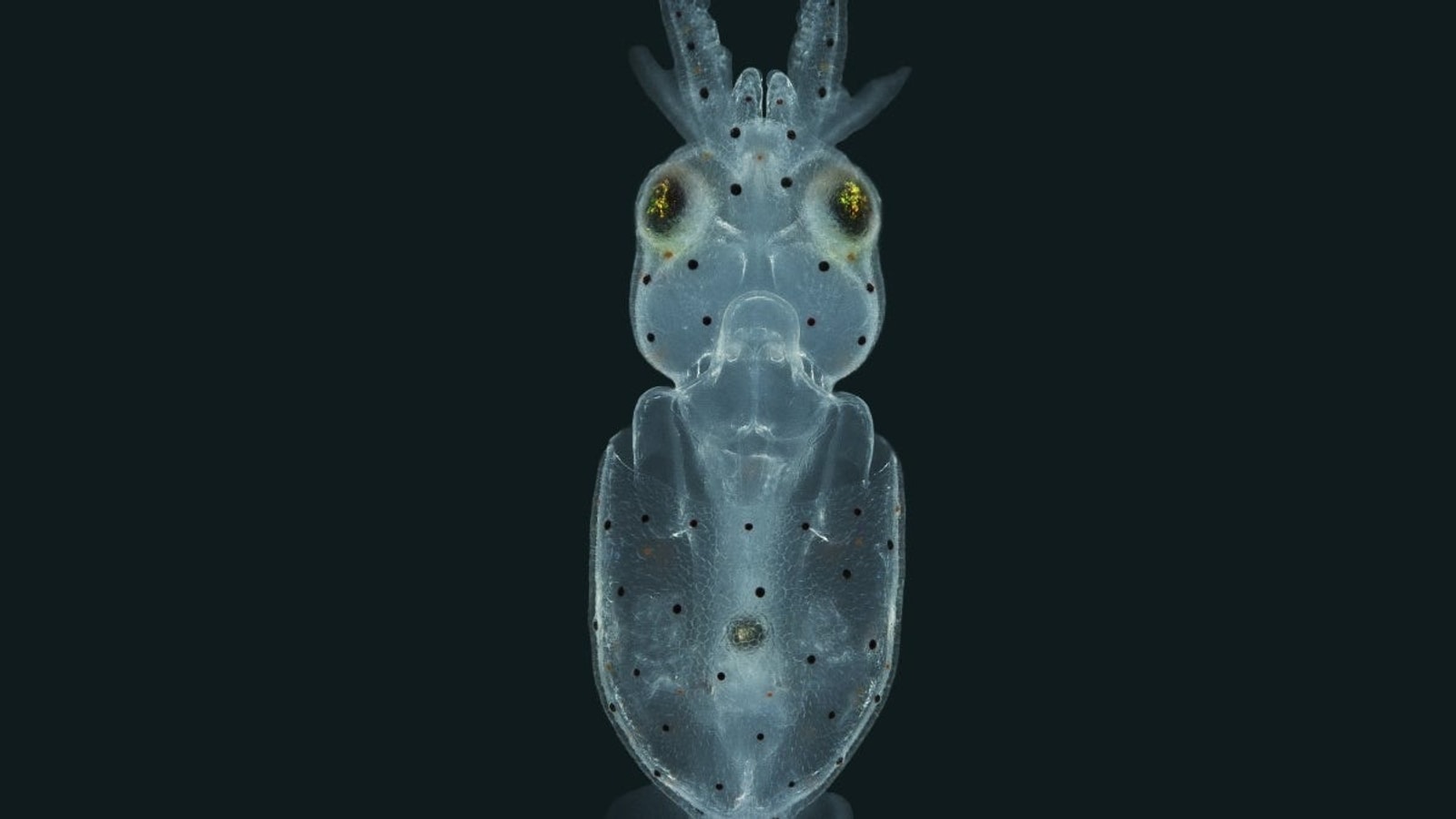
A moving body changes the water around it. Detecting that water can give an animal information about the conditions its movement is creating. A new anatomical study of squid expands the known surface over which that sensing may take place, revealing a distributed arrangement where the familiar picture had been more localized.
The Current Biology paper, “An anatomical map of squid lateral lines,” examines free-swimming paralarvae of Doryteuthis pealeii. The researchers describe hair bundles arranged in dense lines and broad fields across the animal's surface, including stereotyped arrays on the mantle. Neuronal processes from those mantle cells project to the stellate ganglion. The authors interpret the varied arrangements as likely registering particular kinds of local water movement. The paper maps anatomy; it does not establish the complete response of every sensory array.
That distinction makes the finding more interesting, not less. A map reveals where the system can gather information and how its sensing elements are arranged. It opens functional questions that a generalized claim about “squid hearing” would obscure. Which movements reach each array? What directional information can the arrangement preserve? How does the animal distinguish disturbances it creates from those arriving from elsewhere?
For engineering, the useful analogy is a sensing surface whose position matters. This is our interpretation, not a robotic result demonstrated by the study. A machine operating in water could receive different information from pressure or flow sensors placed on different parts of its body. Concentrating every measurement in one instrument might simplify packaging while losing some of the local structure that distributed sensing can retain.
The challenge would be learning what that structure means. An anatomical pattern is not an off-the-shelf algorithm. A robot would still need calibrated sensors, time alignment, a model of its own movement, and tests showing that the signals help it perform a task. Copying the appearance of a biological arrangement would not establish that the copy works. The research offers questions for design, rather than a finished design to imitate.
The same caution applies to the hearing-loss connection in coverage of the work. Hair cells are important to mechanosensation, and comparative biology can help researchers investigate how such cells develop and function. But finding additional sensory cells on a squid is not evidence of a treatment for human hearing loss. The productive step is to study what can be learned from the cells and their organization, without converting a research possibility into a clinical outcome.
A particularly valuable feature of the paper is its attention to variation across the body. Different densities, lengths, and positions suggest that a distributed system need not consist of identical sensors repeating the same measurement. The arrangement itself may help determine what information is available. Functional experiments are needed to establish those roles, but the anatomy makes the hypothesis concrete enough to investigate.
That is the angle worth carrying forward. The finding enlarges the known sensory architecture of an animal and points to specific next measurements. For robotics, it encourages designers to ask what the body can contribute to perception. For biology, it raises questions about the relationship between motion, local flow, and neural interpretation. The surface of the animal may be doing more informational work than the old map allowed.
The study concerns paralarval anatomy. Functional tuning, adult generalization, robotic benefits, and human clinical applications are not established by the abstract.