

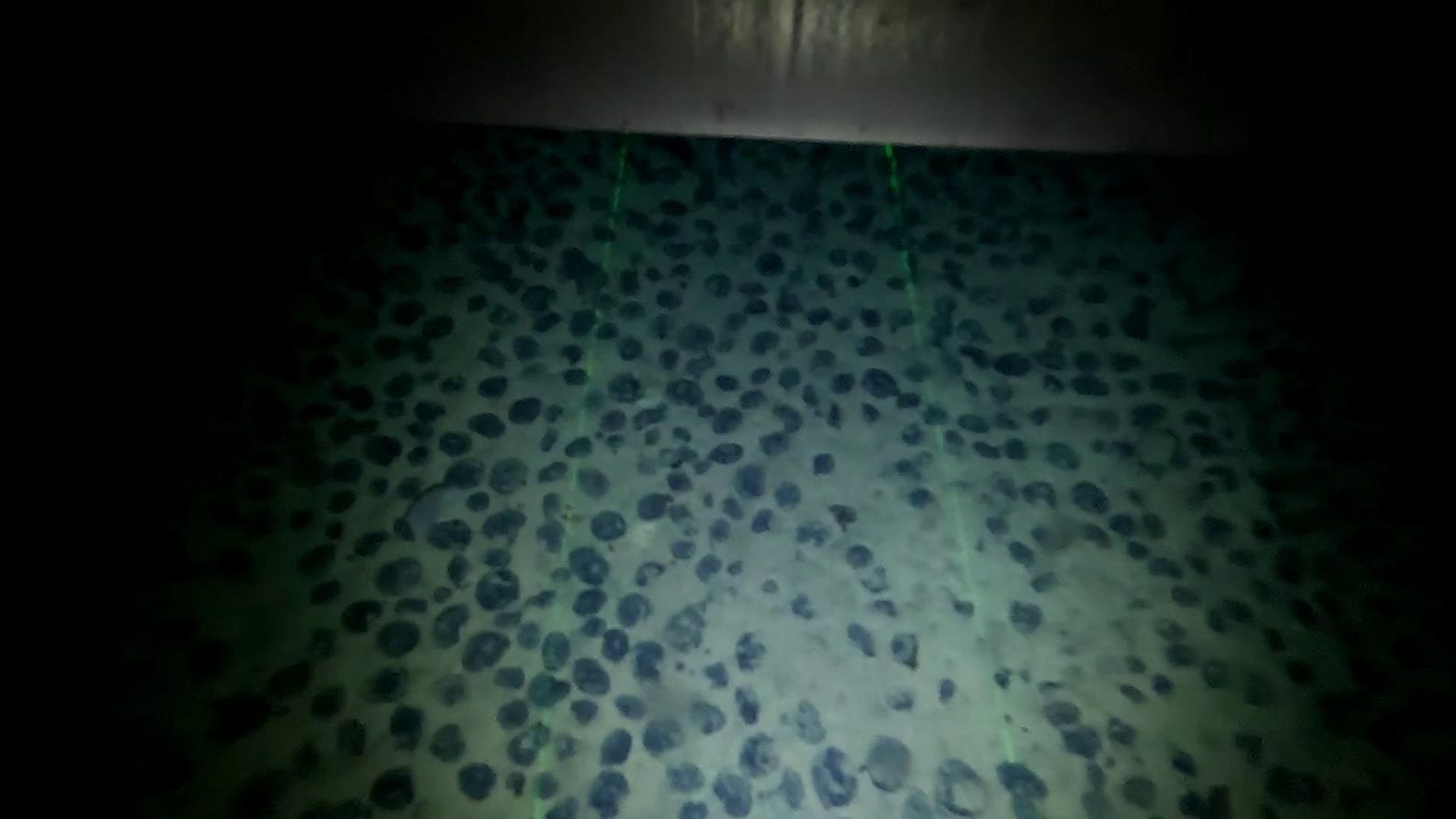
This is exactly the sort of position the Cyberdelia Paper Portfolio was built to test.
TMC is not a mature mining company with operating mines, recurring production and a long history of unit costs. It is a development-stage attempt to create a new commercial source of nickel, copper, cobalt and manganese from polymetallic nodules on the deep Pacific seafloor.
The upside is easy to narrate. The resources are large. Western governments want more secure critical-mineral supply. AI, grids, storage, defense and electrification are increasing the strategic value of many of the same metals. TMC also has an engineering partner in Allseas and a commercial collection system targeted for commissioning in the fourth quarter of 2027, subject to approvals.
The downside is equally obvious: none of that automatically produces a commercial permit or profitable production.
Why enter now?
NOAA published TMC USA's consolidated application for an exploration license and commercial recovery permit in the Federal Register on August 19. The application covers roughly 65,000 square kilometers for the USA-A area and an estimated 619 million wet tonnes of nodules, according to the company. A separate USA-B exploration application is already in environmental review.
The timing creates a testable regulatory catalyst. We are not buying the story that deep-sea mining is inevitable. We are testing whether continued progress through the U.S. process creates enough change in perceived project probability to reward a small, explicitly speculative position.
The physical thesis.
TMC's June 2026 filing says its U.S. application areas are estimated to contain roughly 15.5 million tonnes of nickel, 12.8 million tonnes of copper, 2.0 million tonnes of cobalt and 345 million tonnes of manganese across measured, indicated and inferred resources.
Resource scale creates option value. It does not guarantee recoverability, environmental approval, processing economics, financing or shareholder returns.
The political thesis.
Critical minerals are now part of national-security and industrial-policy planning. USGS says the United States remains heavily import-dependent for many critical minerals, while the IEA warns that refined supply for several strategic materials is highly geographically concentrated.
A domestic legal pathway for seabed minerals could therefore receive policy attention that would have been difficult to imagine when TMC first became public.
That policy tailwind is real. It is also reversible. An investment thesis built entirely on a favorable administration is not a durable operating thesis.
The engineering thesis.
TMC and Allseas signed a commercial framework in May for development, commissioning and operation of the first commercial polymetallic-nodule collection system. TMC says the system is expected to have nameplate capacity of 3 million wet tonnes per year.
Nameplate capacity is not production. Production is not revenue. Revenue is not profit.
Every one of those transitions must eventually be demonstrated.
The portfolio rule.
The simulated allocation is $5,000 from a $100,000 paper portfolio, or 5% of starting capital. At the $5.09 entry snapshot that produces 982.3183 simulated shares.
The position will be benchmarked against SPY from the same date. We will not quietly change the entry after the market moves. The repository commit fixes the initial terms in public version history.
One-month review.
This is not necessarily a one-month investment horizon. It is a one-month audit interval. On September 27, Cyberdelia will compare the position with its entry, SPY, regulatory developments and the published failure conditions.
A rising price without improved evidence will be recorded as a winning trade, not retroactively promoted into proof that the thesis was correct. A falling price with improving evidence will also be separated from the thesis. Price and evidence are related; they are not identical.
TMC / $5,000 simulated / $5.09 entry / 982.3183 shares. Classification: high-risk regulatory and execution speculation. The thesis is that material progress toward a viable U.S. commercial-recovery permit, paired with credible engineering execution and critical-mineral demand, can increase the market's probability-weighted value of TMC's resource base.
Failure conditions
We reassess or close the paper position if commercial-recovery permitting materially stalls or reverses; environmental or legal restrictions make the expected pathway nonviable; financing creates unacceptable dilution or solvency pressure; collection or processing economics deteriorate materially; or new evidence shows the 2027 commissioning pathway is no longer credible.
The point of writing those conditions now is to prevent future us from becoming suspiciously philosophical after losing money.