

Put two recordings beside each other and the timeline seems to assemble itself. One event carries an earlier timestamp. Another carries a later one. The natural next sentence is that the first happened before the second. Sometimes that sentence is justified. Sometimes it silently assumes that the clocks agree, that the timestamps refer to the same stage of recording, and that the delay between the event and its label is negligible. Those assumptions deserve a measurement before they become a story.
False Normal makes timing and cross-instrument comparison part of its investigative method. In one sequence, observers compare camera artifacts and explicitly resist treating an apparent offset as proof. That caution supplies this article's anchor without disclosing what the novel ultimately does with its evidence. Cyberdelia's angle is measurement discipline: precision on the screen is not the same thing as knowledge about the order of events.
A timestamp can describe several different moments. The sensor might attach it when light is sampled, when a frame enters a buffer, when processing finishes, or when a server receives the result. A log entry may be created after the operation it reports. Network transit and queues can add variable delay. Two systems can display the same timestamp format while labeling different stages of their workflows. Their outputs need interpretation before comparison.
There is also the clock itself. Devices can disagree by a fixed offset, drift at different rates, or adjust their clocks during an observation. A correction may create a jump or alter how later times are reported. The displayed number can contain many decimal places while the underlying relationship to a reference remains poorly characterized. More digits provide a finer representation. They do not, by themselves, provide a smaller uncertainty.
NIST's work on timing accuracy in a cyber-physical systems testbed examines how synchronization performance changes across configurations and measurement points. The important lesson for this article is that the location and method of timestamping matter. An accurate reference at one point in a system does not automatically make every application event equally accurate. A timing claim belongs to a specified measurement chain, not to an entire network simply because the network uses a named protocol.
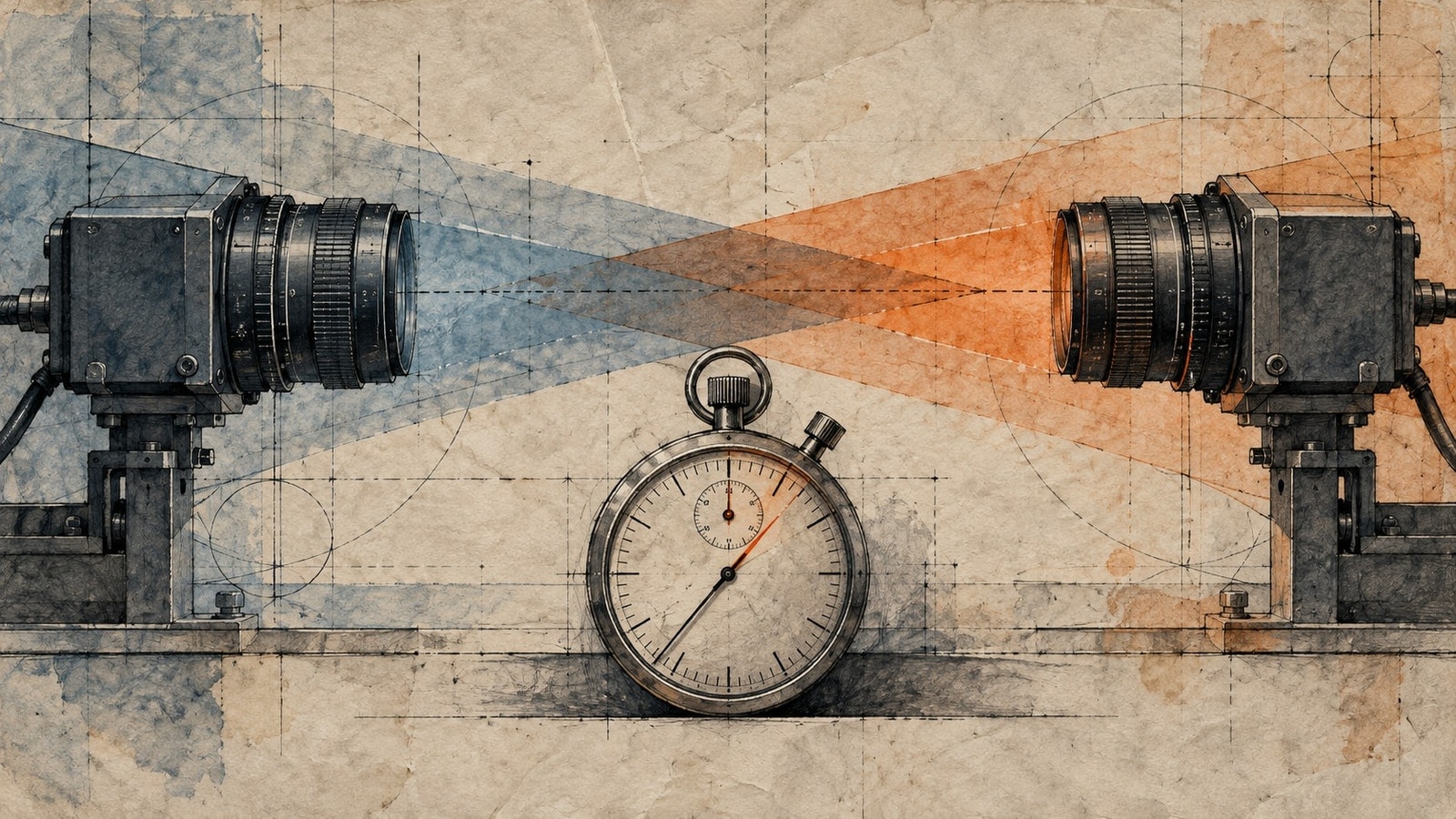
Consider a hypothetical pair of cameras observing a lamp. Camera A labels a flash before Camera B does. That difference could reflect clock offset, different exposure timing, frame boundaries, processing delay, or an actual difference in what each camera observed. A calibration sequence can help distinguish those possibilities. Without one, the most defensible statement may be that the recordings contain an apparent offset whose cause has not been established.
A useful calibration would introduce a shared observable event and characterize how each instrument records it. The setup must suit the question. A visual flash can compare video channels but may not establish the timing of a separate software log. Repeating the test can reveal variability that a single trial hides. The investigator should record the conditions, settings, and uncertainty, then check whether those conditions remained applicable during the event under study.
The uncertainty needs to travel into the conclusion. If the plausible timing error is larger than the apparent separation, the measurements may not establish the order at all. If the separation clearly exceeds a justified error bound, the ordering claim becomes stronger. That still does not establish causation. It narrows one question: whether one observed event preceded another within the measurement's stated limits.
This distinction matters in security investigations. An authentication log, endpoint event, and application record may appear to produce a neat attack sequence. Yet each system can buffer or batch its records, and different clocks may have been synchronized differently. Investigators can often reconstruct a useful order from additional evidence such as request identifiers or causal dependencies. They should not let a sorted spreadsheet conceal timing uncertainties that the other evidence has not resolved.
Physical systems have another complication: the event of interest may not have an instantaneous boundary. A motor begins receiving current, its shaft begins moving, a sensor crosses a threshold, and a camera detects the motion. Which of those is the start? The answer depends on the question. A disagreement between instruments can arise because they are observing different parts of the same process. Defining the event is therefore part of the measurement, not a clerical detail to settle afterward.
Precision Time Protocol and other synchronization mechanisms can support demanding timing work in appropriate environments. They are tools, not blanket warranties. Hardware support, network configuration, reference quality, and timestamp placement affect what can be claimed. A practical review should ask for measured performance at the points that matter. The protocol name on a specification sheet is not a substitute for an error budget tied to the actual deployment.
An error budget makes the assumptions explicit. It identifies known contributions to uncertainty and describes how they are assessed or bounded. Not every project needs laboratory-grade metrology, but every consequential timing claim needs enough accounting to match its ambition. Saying that an event happened roughly a second earlier demands less than asserting a millisecond-scale lead. The language of the conclusion should reflect that difference.
Reports should preserve the original timestamps alongside any normalized timeline. If an analyst applies an offset or converts time zones, that transformation should be recorded. A normalized timeline is useful for readers, but retaining the source values makes corrections possible when a calibration changes. Otherwise a later investigator may inherit a polished chronology without knowing which numbers came from instruments and which came from analysis.
The discipline is simple to state and difficult to maintain under pressure. Define the event, identify the timestamping point, characterize the clocks, measure the delays, and state the uncertainty. Then keep the causal claim separate. Two timestamps are an invitation to investigate a sequence. They become a reliable sequence only when the measurement chain earns that conclusion.
The order displayed by two recordings can depend on clocks, buffers and timestamp placement. A chronology needs a defined event and an honest error budget.
Nine technologies behind False Normal
Independent technical essays inspired by manuscript concepts. No plot recap or ending reveals.
- The Implant Outlives the Company. Who Keeps the Body Working?
- A Scanner Finds a Match. The Institution Invents the Rest.
- The Person Watching Your Vitals Should Not Automatically Own Your Day
- When Your Eyes Come With a Ranking System
- A Perfect Hash Can Preserve a Perfect Lie
- The Air Gap Ends Where the File Begins
- An AI's Permission Slip Should Expire
- Two Timestamps Are Not Yet a Sequence of Events
- A Digital Tripwire Tells You Something Touched It. Now What?