

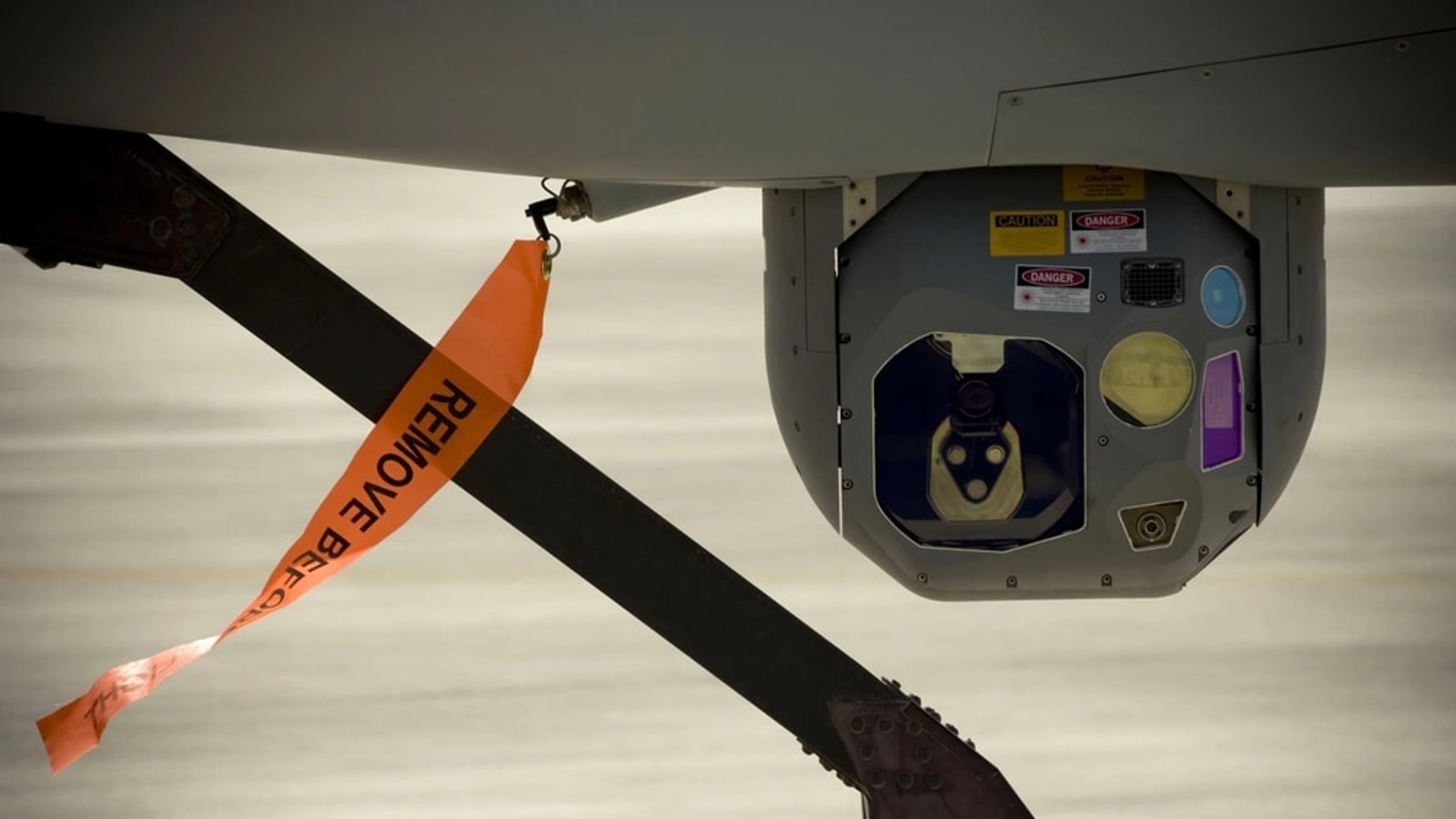
There is a bad habit in anomalous-phenomena arguments: people treat a video as if it were a transparent window onto an object. It usually is not. A video is the final product of a measurement system, and measurement systems have personalities. They saturate. They sharpen. They blur. They rescale. They compress. They make decisions about contrast. Then, sometimes, somebody points another camera at the first camera's display and the evidence takes one more trip through the machinery.
That is exactly why the August 7, 2026 AARO releases deserve a different kind of attention. AARO's own descriptions state that several of the “cold orb” clips are secondary captures recorded with a cellular device from an infrared sensor display aboard a U.S. Special Operations Forces AC-130J. AARO explicitly warns that these are not native primary sensor data and that filming the screen can introduce blur, flicker, and other loss of fidelity.
This does not make the footage useless. It makes the question more precise: what information survived the chain?
Start with the chain, not the conclusion.
The public video can be modeled as a sequence:
physical source → atmosphere → infrared optics and detector → onboard processing → aircraft display → cellphone camera → video compression → public file
Each arrow is a place where information can be transformed. If we do not separate those stages, we can easily assign a display artifact to an aircraft, a compression artifact to a propulsion system, or a contrast inversion to an exotic temperature.
1. The physical source
An infrared sensor does not simply read “temperature.” It detects radiation in a particular spectral band. The radiation reaching the sensor depends on the source's temperature, its emissivity, reflected radiation, viewing geometry, and the surrounding environment. Two objects at the same physical temperature can appear different in infrared if their surfaces radiate differently.
2. The atmosphere
Infrared radiation then crosses atmosphere. Water vapor and other gases absorb and re-emit radiation differently across wavelengths. Humidity, haze, cloud, range, and the sensor's bandpass can change apparent contrast. A weakly contrasting object can become difficult to distinguish at long range even when the sensor itself is functioning perfectly.
3. The sensor and its processor
The detector converts incoming radiation into an electrical signal. Then software turns that signal into an image humans can use. That processing can include non-uniformity correction, noise reduction, digital zoom, edge enhancement, stabilization, contrast stretching, automatic gain control, polarity selection, reticles, and overlays.
Automatic gain control deserves special suspicion in viral infrared footage. The system may continuously remap brightness so that useful contrast remains visible. A target can appear to change dramatically when the display scale changes even if the target's underlying radiance barely changes.
4. The display
The operator does not stare directly into the detector. They see a rendered display. That display has a finite resolution, refresh rate, brightness curve, and pixel structure. It may also show symbology, tracking gates, crosshairs, zoom states, or mode changes that are meaningful to the operator but ambiguous after the fact.
5. The cellphone pointed at the display
Now the evidence passes through a second optical system. A phone camera introduces its own exposure control, focus behavior, rolling shutter, frame rate, stabilization, sharpening, denoising, and compression. Filming a display can produce moiré patterns, aliasing, flicker, ghosting, and apparent motion that did not exist in the source feed.
AARO calls this limitation out directly. That is important. The office is not asking the public to pretend the secondary recording is equivalent to raw sensor output.
“Cold” is a description, not yet a thermometer reading.
The phrase “cold orb” is rhetorically powerful because it sounds like a direct physical measurement. The public material does not justify that leap by itself.
In thermal imaging, apparent brightness or darkness depends on the sensor mode and processing. A dark object in one palette can indicate lower radiance relative to its surroundings, but that is not automatically identical to a calibrated surface temperature. Emissivity matters. Reflections matter. Atmospheric transmission matters. Display polarity matters. Automatic contrast adjustment matters.
The more disciplined formulation is: the source was reported as presenting infrared contrast interpreted as cold relative to its background or sensor presentation. To turn that into a reliable physical temperature, we would want calibrated native data and the parameters required to interpret it.
What survives well?
Even a secondary capture can preserve useful structure. We can often inspect approximate morphology, relative position in the field of view, timing of mode changes, whether the sensor operator is actively tracking, whether the target leaves or re-enters the frame, and whether visual behavior changes when the imaging mode changes.
That last point is especially useful. If an apparent feature disappears when the sensor changes mode, that does not prove the feature was an artifact, but it tells us the feature depends on the measurement channel. That is evidence about the sensor-object interaction rather than merely about the object.
What does not survive reliably?
Precise temperature, physical diameter, true range, true speed, spectral characteristics, and subtle edge geometry are much harder to recover from a screen recording without the original telemetry. A four-foot size estimate, for example, implies some range or angular-size basis somewhere in the original reporting chain. If the public file does not preserve that basis, the estimate cannot simply be independently re-derived from pixels.
Likewise, motion in the image plane is not physical velocity until range, line of sight, platform motion, sensor slew, field of view, and stabilization are accounted for. A target centered by a tracking system can be moving rapidly, slowly, or almost not at all. The picture alone does not tell you which.
The evidentiary hierarchy should be explicit.
For UAP analysis, Cyberdelia will treat sensor evidence in layers:
Tier 1: calibrated native sensor data with metadata and platform state.
Tier 2: native imagery without full metadata.
Tier 3: exported or transcoded imagery.
Tier 4: secondary recordings of displays.
Tier 5: copies of copies, social-media derivatives, screenshots, and edited compilations.
The lower the tier, the more modest the claims should become. This is not skepticism as theater. It is basic instrumentation discipline.
The August “cold orb” footage is worth studying, but its most important public fact may be the one printed in AARO's own description: much of it is secondary imagery. Any analysis that skips the capture chain and jumps directly from pixels to exotic craft performance is outrunning the evidence. The correct next demand is not belief or dismissal. It is native data, calibration context, geometry, and metadata.
What would resolve the case better?
For this class of report, the highest-value release would include the native sensor file, exact sensor model or at least relevant performance characteristics, platform position and attitude, sensor line-of-sight angles, zoom and field-of-view state, range estimate and how it was obtained, relevant radar tracks, time synchronization, weather profile, and any contemporaneous multisensor detections.
That dataset would not guarantee an extraordinary answer. It would do something more useful: it would make extraordinary and ordinary answers compete on the same measurable ground.