


A signature creates a starting condition
Vietnam became the seventy-eighth Artemis Accords signatory on October 28, according to NASA. Science and Technology Minister Vũ Hải Quân signed during Vietnam International Digital Week in Ha Long. The announcement places the decision alongside existing Earth-observation cooperation and domestic satellite development. Those are concrete starting points for examining what participation could produce. They are not a published contract for a lunar mission. [1]
The useful question is what changes after the photograph. A diplomatic commitment can reduce uncertainty about how institutions intend to behave. An operating project must still establish who pays, who supplies equipment, who accepts the results and who answers when something fails. These are connected layers of cooperation, but their evidence arrives at different times.
Cyberdelia's assessment is that implementation deserves its own scoreboard. Counting signatures measures the reach of a framework. It cannot, on its own, measure scientific access, engineering compatibility or the distribution of benefits. Treating the count as the whole story leaves the most interesting work off the page.
Build a cooperation ledger
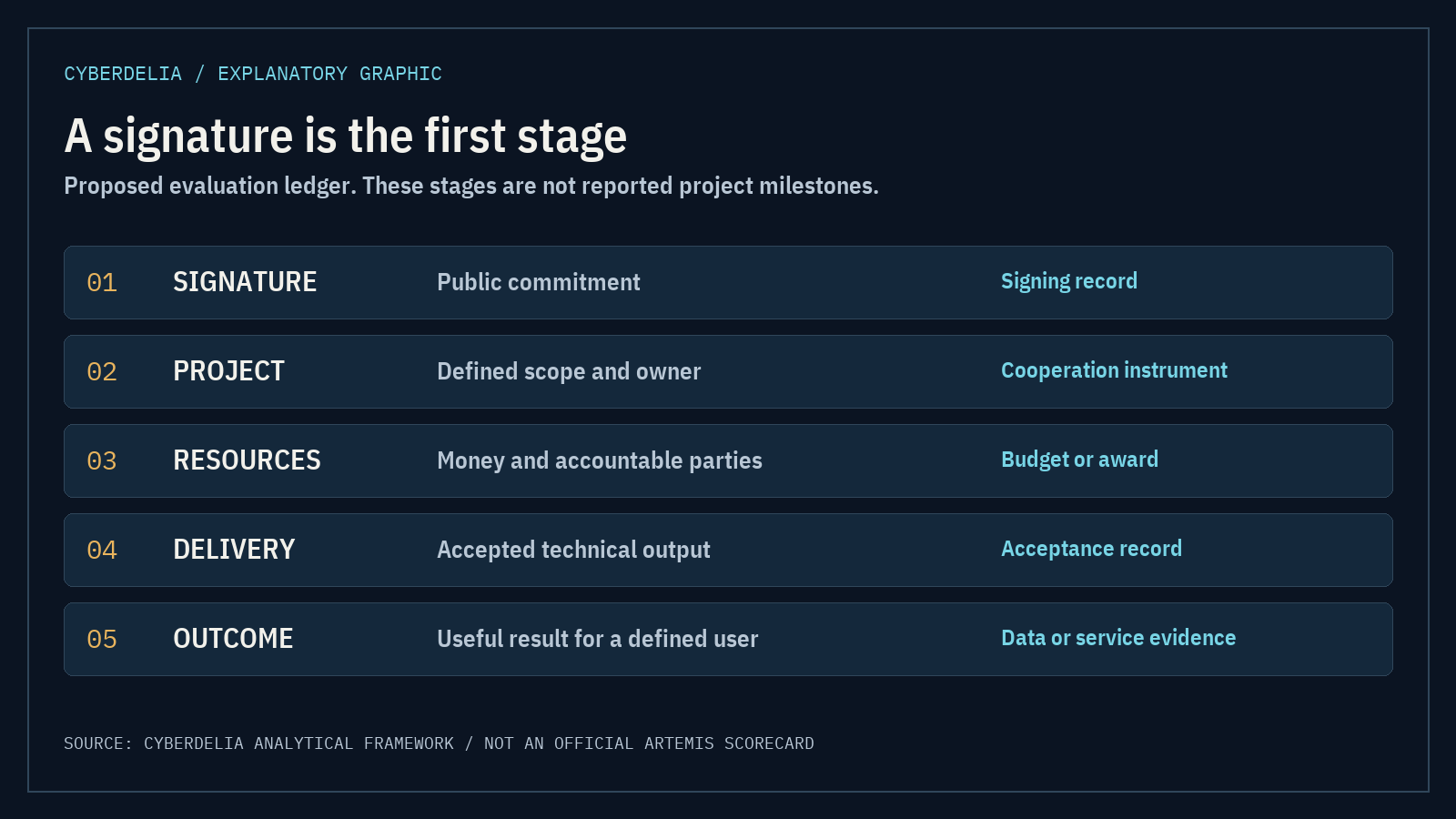
A practical ledger would begin with the announcement and then track four further stages: a defined project, a funded commitment, an accepted technical deliverable and an observable outcome. The stages are an editorial evaluation method proposed here, not an official grading system. Each needs a different document. A memorandum might identify a project; a budget or award might establish resources; an acceptance record might establish delivery; a dataset or service report might show usefulness.
The distinction protects ambitious projects from a common reporting error. A project can be worthwhile before its final outcome is visible. That does not justify treating its intended benefits as already delivered. Conversely, the absence of an immediate spacecraft launch does not make a cooperation framework empty. Early benefits may involve training, measurement practice or a scientific collaboration that is much less photogenic.
For any future Vietnam-related announcement, the ledger should record a named responsible institution, a date, a measurable output and a public verification route. Where a detail is unavailable, the cell should remain unknown. Replacing an unknown with an optimistic sentence produces cleaner copy and worse analysis.
Compatibility needs an acceptance test
The Accords identify interoperability as an objective and envisage follow-on arrangements for specific cooperation. They also describe a political commitment rather than a self-executing schedule of funded missions. That architecture makes implementation documents essential evidence. The original framework establishes intentions; later instruments must carry much of the operational detail. [2]
Consider a hypothetical instrument supplied by one institution to another. Mechanical attachment is only one interface. The receiving team also needs to understand electrical limits, timing, data format, calibration, software behavior and responsibility for changes. A successful demonstration under one laboratory setup does not settle whether the equipment will remain useful in another team's workflow.
An acceptance test could specify which measurements must be reproduced, under what conditions and with what error bounds. It should identify who has authority to approve a deviation. Otherwise, two partners can both say their subsystem works while the combined system fails. The resulting dispute is often described as a communication problem, even when the real missing component is a written decision rule.
This example is a proposed way to evaluate future cooperation. It is not a claim that Vietnam has committed to supply such an instrument, or that a particular interface has already failed.
Data access is a chain
The framework includes commitments concerning scientific data, while retaining qualifications concerning proprietary information, export controls and private-sector operations. Reading those provisions together matters. A broad promise of openness does not establish that every product from every activity will be public. The scope of a particular activity and its implementing arrangements remain relevant. [2]
For a reader evaluating a future public dataset, accessibility should mean more than a working download button. Useful evidence includes a description of what was measured, the units, the coordinate or time reference where applicable, calibration information, version history and clear usage conditions. These are proposed reporting questions, not requirements we have verified for a newly announced Vietnamese dataset.
A hypothetical flood-mapping project illustrates the difference. A file might be publicly available yet arrive too late for the decision it is intended to support. Another might arrive promptly but require processing tools that a local agency cannot maintain. An outcome assessment should ask whether the intended user could perform the relevant task, rather than merely count released files.
This approach also prevents a misleading technology narrative. More data is an input. Better decisions are an outcome that needs separate evidence. A cooperation announcement cannot bridge that gap simply by placing the two claims in the same paragraph.
Small contributions need a path to continued use
A less visible contribution can be strategically important if other participants can reliably use it. A calibration procedure, maintained software tool or repeatable analysis method may have value beyond the size of the institution producing it. That is an analytical possibility, not a forecast of any particular Vietnamese contribution.
The test is dependency. If a partner relies on a tool, what happens when its original developer leaves, a license changes or a component becomes unavailable? Documentation and continuity arrangements belong in the evaluation of cooperation because a one-time delivery can create a long-term service obligation. The ceremony rarely tells us how that obligation will be supported.
Procurement and research incentives can pull in different directions. A research team may be rewarded for novelty; an operational user may need stability. Neither preference is inherently unreasonable. A mature collaboration needs a handoff that acknowledges both. Reporting should look for that handoff instead of assuming that publication, demonstration and sustained service are interchangeable achievements.
The strongest skeptical case
The skeptical argument is straightforward: a growing coalition can generate a large volume of diplomatic activity without proportionate engineering or scientific output. Public announcements are relatively easy to produce. Projects require sustained resources, and a framework can become a substitute for the harder decisions if nobody measures implementation.
That criticism deserves an answer grounded in observable work. A list of future ambitions is insufficient. So is dismissing the framework because its benefits cannot be measured the next morning. Some coordination work creates value by preventing incompatibility or delay, effects that are difficult to see without a counterfactual.
A reasonable evaluation therefore uses milestones within a project's control. Did the parties publish a scope? Did the promised access or deliverable arrive? Were revisions documented? Can an outside researcher inspect the outcome? These questions allow a project to demonstrate progress before its largest ambition is realized, while keeping failure visible.
The strongest favorable case is that early agreement on practices lowers the cost of building partnerships. To support that claim in a specific case, look for evidence of a faster or clearer handoff, fewer unresolved interface questions or a collaboration that could not previously proceed. Coalition membership alone does not establish causation.
A scoreboard with denominators
A useful public record should retain failed and delayed projects alongside successful ones. Otherwise, a collection of celebratory announcements becomes a survivor-biased archive. Record what was promised at the time, keep subsequent changes visible and distinguish cancellation from indefinite silence.
The denominator matters. If five projects are announced and two deliver, the reader needs to know about all five before interpreting the two successes. That example is illustrative; Cyberdelia is not reporting a five-project Vietnamese portfolio. It demonstrates why counting positive press releases cannot measure a program's delivery rate.
Similarly, spending, participation and output should occupy separate columns. More money may expand capacity without proving efficiency. More participants may broaden access without proving equal influence. More outputs may indicate activity without establishing quality. A transparent ledger can show these tensions without forcing them into a single score that hides its assumptions.
For this signing, the available evidence establishes entry into the framework. We have not established a new funded Vietnam-specific lunar deliverable, a quantified economic benefit or an implementation timetable. Those remain open reporting questions.
Ask who can reproduce the result
An outside verification route should be designed before the celebratory report. If the promised output is software, identify a reproducible example and the conditions required to run it. If the output is training, identify the capability participants are expected to demonstrate afterward. If it is a scientific service, identify the decision it is supposed to improve and the evidence needed to evaluate that improvement.
These questions should be proportional to the activity. A small research exchange does not need the paperwork of a major flight program. It still needs a claim clear enough to assess. Proportionate accountability preserves useful experimentation without turning every informal collaboration into an administrative obstacle course.
CYBERDELIA ASSESSMENT / What would change our assessment
The next evidence worth watching is a specific cooperation instrument with accountable parties, resources and a testable output. Public technical documentation or a usable scientific release would strengthen the case that the signing is turning into practical collaboration. A persistent sequence of announcements without inspectable follow-through would strengthen the skeptical case.
The review should also permit mixed results. A collaboration might deliver useful research while missing a schedule or distributing benefits unevenly. Calling it simply a success or failure would erase the information needed to improve the next project. Cyberdelia would assess the separate claims against the evidence supporting each.
Vietnam's signature is a real diplomatic event. Its longer-term significance is a question that should remain measurable. The interesting story begins when a principle becomes an interface, the interface becomes an obligation, and someone outside the ceremony can check whether the obligation was met.
Source trail
Corrections and updates
Published analysis dated October 29, 2026. Sources checked on that date. Send a specific correction with supporting evidence through the correction trail. Material changes will be identified here.