
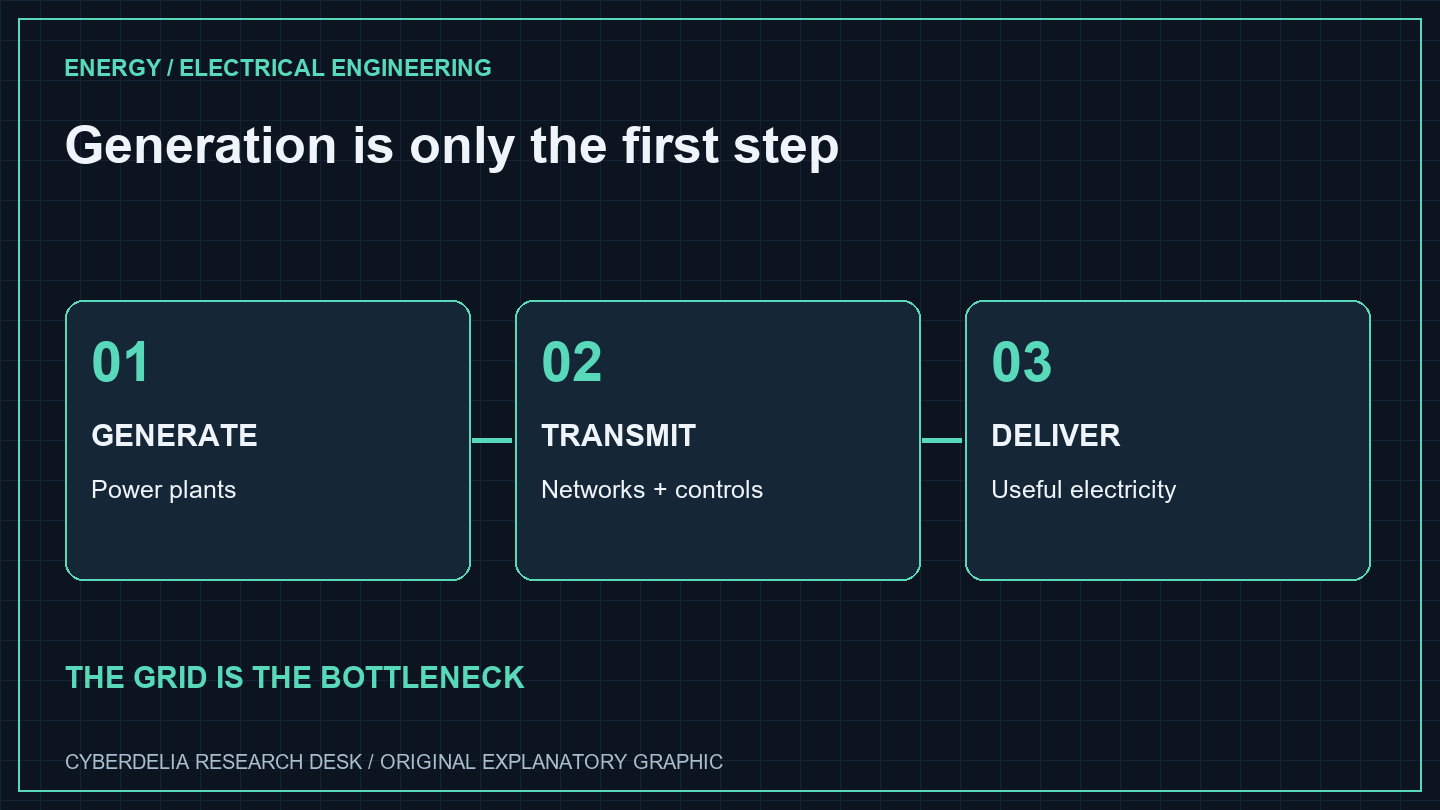
The world installed a record 692 gigawatts of renewable generation in 2025. In an October 27 assessment, the head of the International Renewable Energy Agency expects annual additions to decline. The underlying engineering problem is not a shortage of ways to generate clean electricity. It is the growing difficulty of delivering that electricity where and when it is needed.
The great electrical mismatch
An electrical generating station is only useful if its output has somewhere to go. That sounds obvious enough to be insulting. Unfortunately, modern energy planning has spent a remarkable amount of time treating the construction of generating capacity as if it were the same achievement as delivering useful electricity. Solar panels became cheaper. Wind turbines became more efficient. Investors financed enormous installations. Governments announced impressive gigawatt targets. Meanwhile, the electrical networks connecting those installations to actual consumers remained constrained by geography, aging equipment, construction timelines, and operating requirements.
The mismatch is beginning to show in global expansion figures. On October 27, Francesco La Camera, director-general of the International Renewable Energy Agency, told Reuters that worldwide renewable-power capacity additions are expected to decline in 2026. If that assessment proves correct, it would interrupt a multiyear sequence of rising annual installations. The previous year established an extraordinary benchmark. According to IRENA, the world added approximately 692 gigawatts of renewable generating capacity during 2025, bringing total installed renewable power capacity to 5,149 gigawatts. That represents roughly 15.5% growth in the installed renewable base.
The important distinction is that 2026's expected slowdown is a forecast. The final annual data is not yet available. But the physical problem behind the forecast already exists. The world can manufacture generating equipment faster than many electrical networks can accommodate it.
A gigawatt on paper is not a gigawatt at the socket
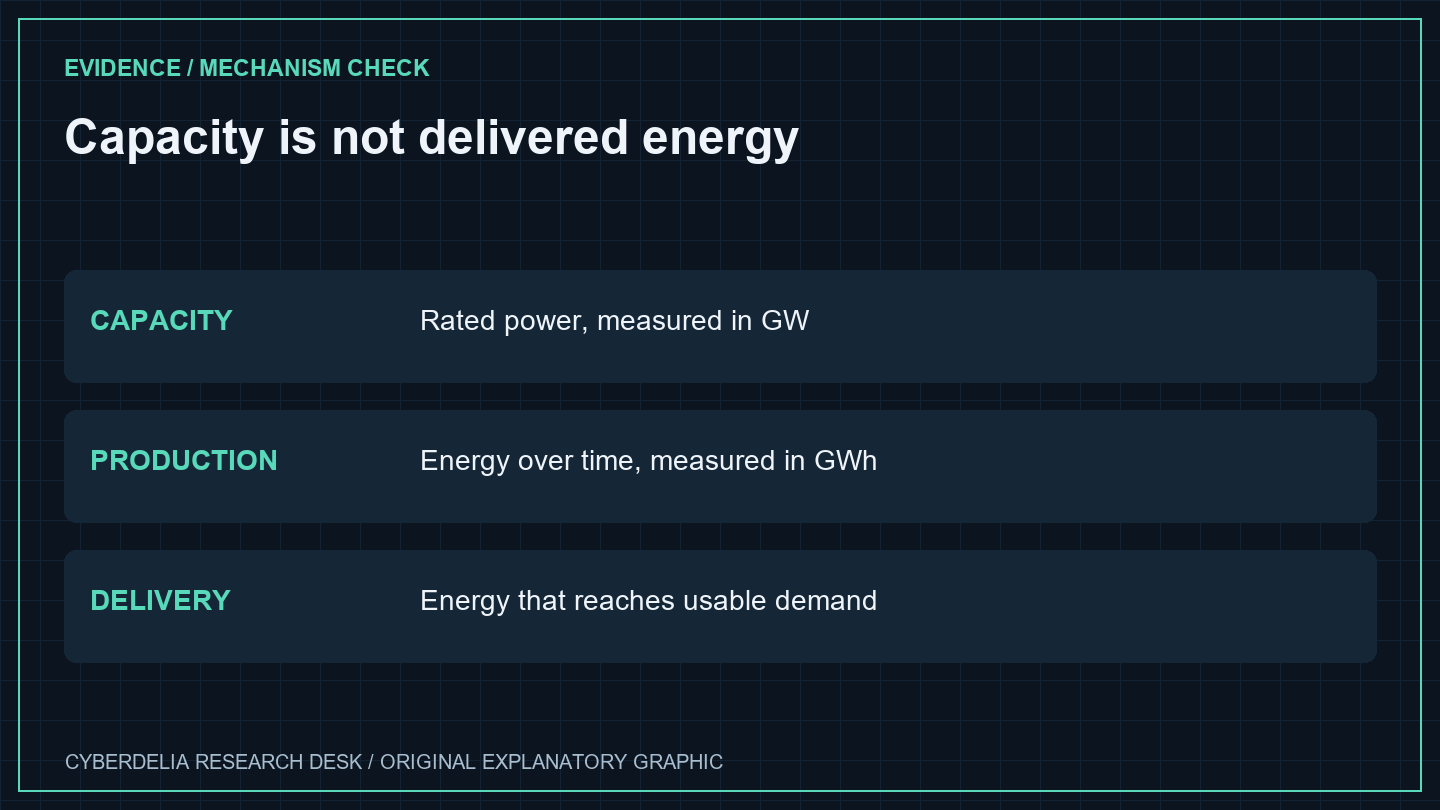
Electrical capacity is frequently reported in watts, kilowatts, megawatts, and gigawatts. Those units measure power, not energy. A one-gigawatt generating installation has a nominal maximum output of one billion watts under specified conditions. It does not necessarily produce one gigawatt continuously. Solar generation changes with sunlight, weather, season, panel orientation, temperature, and equipment condition. Wind generation varies with atmospheric conditions and turbine operating limits. The electricity available over time depends on the operating profile. Energy production is measured in watt-hours, typically megawatt-hours or terawatt-hours for large systems.
This distinction becomes important when comparing electricity projects. Two generating facilities can have the same installed capacity and produce very different quantities of electricity during a year. They can also have dramatically different value to the grid. A power plant producing electricity during periods of high demand may be more valuable than a plant producing the same annual energy when demand is already satisfied and the network is congested. The problem becomes more difficult when hundreds of projects enter the system at once. The electrical grid must balance production and consumption continuously while preserving voltage, frequency, and equipment limits.
It also has to move energy across transmission corridors that were not necessarily designed for the new geography of generation. A solar installation in an excellent desert location can be commercially useless during some periods if transmission capacity into distant population centers is unavailable. The generating equipment may be functioning perfectly. The system surrounding it is not.
China: the cost of generating electricity nobody can accept
China offers the clearest large-scale example of the problem described in the October 27 assessment. Its renewable-energy manufacturing and deployment capabilities have expanded rapidly. Large solar and wind installations can be constructed at extraordinary scale, but electricity demand and transmission access do not always increase in the same places or at the same times. When a network cannot absorb available generation, operators may curtail production. Curtailment means reducing or refusing generating output that could otherwise have been produced. This can occur because transmission lines are congested, local demand is insufficient, other generators face operational constraints, or maintaining system stability requires balancing action.
Curtailment is not automatically evidence of incompetent engineering. Some degree of unused potential output may be economically reasonable in a system optimized for overall cost. But persistent, substantial curtailment can indicate that generation investment and network development are badly misaligned. Reuters reported substantial Chinese curtailment in the first half of 2026. This article does not independently reconstruct that volume, so it does not use the report's country-scale energy comparison as a measured result. Such comparisons communicate scale, but they require methodological caution. National electricity demand is an energy quantity, while installed generating capacity is a power quantity. They cannot be treated as interchangeable.
A more useful engineering question is how much potential electricity was rejected, where that curtailment occurred, and what infrastructure would have been required to use it. If the rejected energy could have reached industrial consumers, what additional transmission capacity would have been necessary? If local demand was temporarily insufficient, could storage have shifted delivery into another part of the day? If transmission development would cost more than the electricity recovered, would accepting some curtailment actually be the economically rational outcome? Those are testable questions. Simply declaring that curtailed electricity represents failure is not enough.
Why building the grid takes longer
A renewable installation is a collection of technically demanding components, but many of them can be manufactured repeatedly. Solar panels, inverters, mounting structures, electrical protection equipment, and standardized project designs benefit from industrial production. Transmission infrastructure is less accommodating. High-voltage lines require corridors across real land. Substations require specialized equipment, suitable sites, and connections to existing networks. Projects encounter environmental assessment, land acquisition, regulatory approval, engineering studies, equipment procurement, and construction challenges. Large transformers and high-voltage switchgear can have long delivery times. Skilled crews must build and commission systems whose failure could disrupt millions of customers.
Unlike a factory assembling identical products, each major transmission project is shaped by geography and the network into which it must connect. The physical timeline can be difficult to compress. There is also a coordination problem. The entity building a generating station may not be the same organization responsible for upgrading the transmission line it needs. The economic benefits of a network upgrade may be spread across many participants, while construction expenses are concentrated on a utility, transmission operator, or government authority. That can create a gap between projects that are profitable individually and investments that are necessary for the overall system to function.
Australia and Japan face variations of the same problem
The IRENA assessment also identified Australia and Japan as examples of countries where network development has struggled to keep pace with renewable deployment. The common problem does not imply identical causes. Australia has enormous renewable resources, widely separated population centers, and significant distances between generation opportunities and major loads. Its power system must accommodate changes in where electricity is generated, how it travels, and which technologies provide essential system services. Japan faces a different geography. Its mountainous terrain, densely populated areas, and complex electricity infrastructure place constraints on network expansion.
Japan's historical regional grid structure also includes different AC frequency areas, creating additional considerations for transferring electricity between portions of the country. The resulting infrastructure problems cannot be solved with a universal template. A transmission project that makes sense across sparsely populated land may be impractical in a densely developed region. A battery that relieves a local afternoon solar surplus may not provide enough storage for a prolonged winter generation deficit. Different problems require different combinations of physical equipment and operating strategies.
Storage is useful, but it cannot make wires disappear
Energy storage is frequently presented as the obvious answer to renewable variability. Sometimes it is. A battery can absorb surplus electricity, respond rapidly to changing network conditions, and supply power when demand rises or generation falls. Storage can also reduce some local congestion by shifting energy through time. But storage cannot automatically solve a transmission problem. Suppose a renewable installation is located far from a population center. A large battery at the generating site may shift its output into the evening, but the transmission line still has to carry that electricity to the population center.
If the transmission corridor is fundamentally inadequate, storage may improve utilization without eliminating the bottleneck. Alternatively, placing storage near consumers might reduce peak transmission demand and provide valuable backup capability. The optimal location depends on the network. Power electronics also matter. Modern inverters can help regulate voltage and frequency, but their capabilities vary by design and configuration. A growing share of inverter-based generation changes the way system operators maintain stability, detect faults, and recover from disturbances. Grid-forming controls, synchronous condensers, protection-system upgrades, and other technologies may be necessary depending on the network.
The electrical transition is therefore not simply a question of building additional batteries. It is an exercise in coordinated system engineering.
What Cyberdelia would actually measure
The most useful investigation would compare installed renewable capacity with electricity delivered and electricity curtailed. For each country or grid region, Cyberdelia would seek five classes of data. First, the installed generating capacity by technology, location, and commissioning date. Second, actual energy production and curtailment, ideally at hourly or finer resolution. Third, transmission capacity and congestion records showing where electricity movement is constrained. Fourth, grid-connection queues and the average time required to connect new projects. Fifth, the cost and performance of alternatives such as storage, transmission reinforcement, flexible demand, and local generation.
These datasets would reveal more than a simple ranking of countries by renewable gigawatts. Consider two hypothetical regions. Region A has installed ten gigawatts of solar generation but regularly curtails a substantial fraction of its midday output. Region B has installed eight gigawatts, but its network and demand profile allow it to use a higher proportion of available production. It is entirely possible that Region B delivers more useful annual renewable electricity, despite having less nominal capacity. That conclusion would depend on actual hourly output, demand, and network records. Capacity alone cannot settle it.
The analysis could also calculate the marginal value of additional investments. Would another gigawatt of generation produce more useful electricity than a network upgrade? Would demand-response programs reduce congestion more cheaply than a new transmission corridor? Would a particular battery installation meaningfully reduce curtailment, or merely relocate the problem? This is the point where energy reporting becomes engineering.
The forecasting problem
IRENA's director-general expects global renewable capacity additions to decline during 2026. He did not provide Reuters with a precise quantitative forecast. That limits what can honestly be concluded. We cannot yet calculate the final percentage decline, identify the ultimate ranking of national contributions, or establish how much of the change will result from grid constraints rather than trade barriers, financing conditions, policy shifts, or manufacturing cycles. The 2025 figures are measured historical statistics. The 2026 decline is an informed forecast. The infrastructure mismatch is an observable, longstanding engineering problem whose precise contribution to annual deployment must still be established.
Keeping those distinctions visible is necessary for a meaningful assessment.
Electricity is a system, not a collection of machines
Renewable power has reached a scale where its next constraints are increasingly systemic. The technology for generating electricity is mature enough to support extraordinary deployment. Yet the network must still accommodate the resulting power flows, preserve stability, serve changing demand, and provide economically viable connections. A solar panel does not care whether the transmission line is overloaded. A wind turbine does not know whether electricity prices have collapsed during a local surplus. A factory does not benefit from a distant gigawatt that cannot reach its electrical equipment.
The next great infrastructure challenge may therefore be less glamorous than another record-breaking generation announcement. It involves conductors, transformers, substations, power electronics, storage, protection systems, grid software, and the coordination needed to make them function together. We learned how to manufacture clean generating capacity at industrial scale. Now we have to demonstrate that we can build the electrical systems required to use it. The real measure of progress is not how much equipment stands in a field. It is how much dependable electricity reaches the people and machines that need it.
Source trail
- IRENA, Renewable Capacity Statistics 2026
- IRENA, Renewable capacity highlights 2026
- Reuters, October 27 forecast (syndicated by EnergyNow)
- IEA, Electricity Grids and Secure Energy Transitions
Corrections and updates
Published November 13, 2026. Send specific corrections and supporting evidence through our corrections page. Material revisions will be recorded here.