
CONSERVATION / REWILDING / DE-EXTINCTION
You Made a Mammoth. Now What?
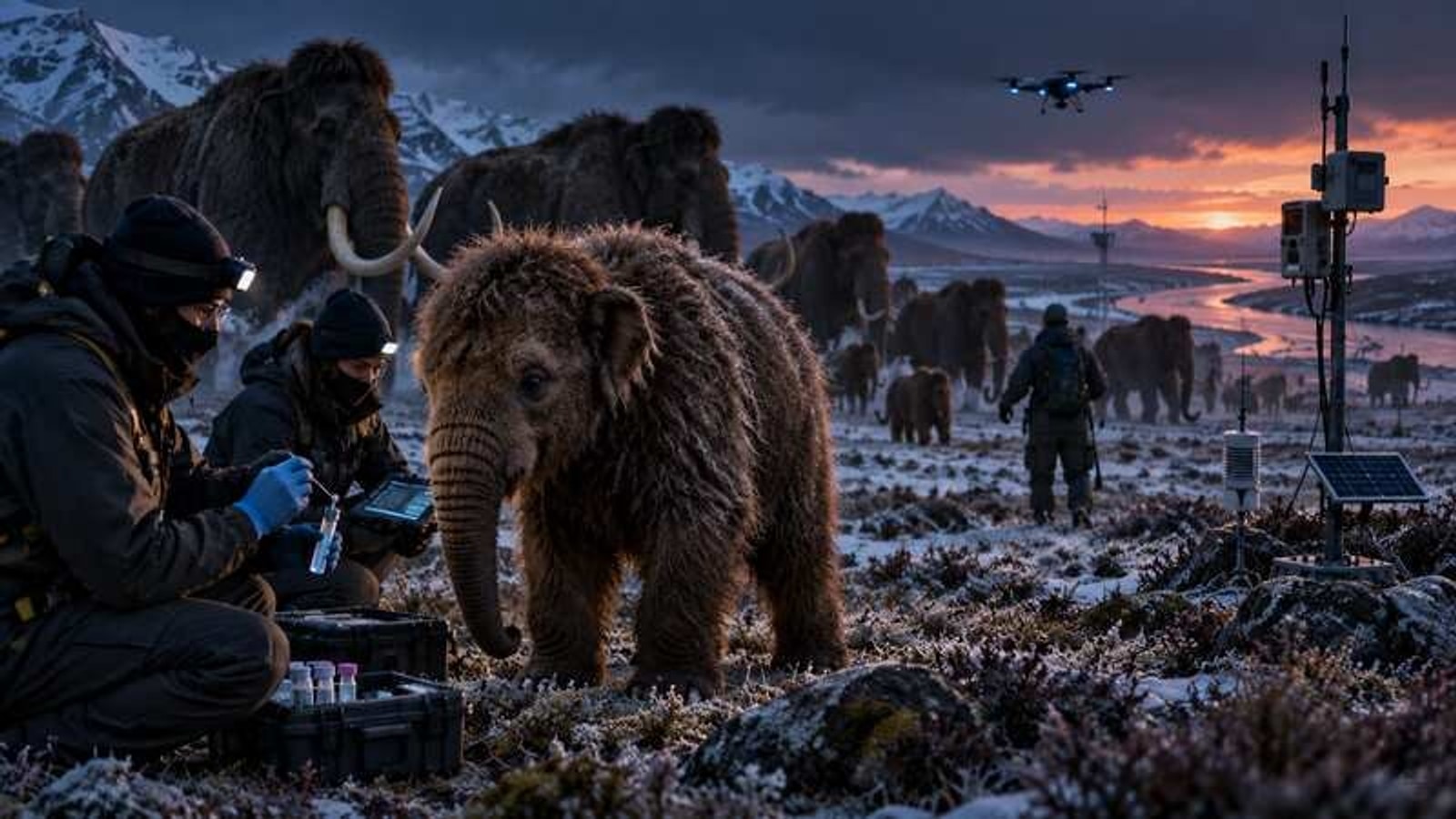
Birth is not release. A mammoth proxy would enter a world with modern pathogens, modern vegetation, modern politics and no living mammoth culture. Rewilding would be a separate experiment with its own failure modes.
By Cyberdelia Research Desk · September 10, 2026 · Method: conservation-risk and ecological-function analysis

The first mammoth would not be a conservation victory
If a mammoth-like calf is born, the photograph will be irresistible. It will also tell us remarkably little about whether de-extinction has succeeded in any conservation sense.
A healthy birth would establish that a particular reproductive pipeline worked once. It would not prove that the animal can regulate temperature as intended, develop normal joints, digest Arctic forage, resist contemporary disease, reproduce, form stable social groups or alter an ecosystem in the desired direction. Those are separate hypotheses.
This matters because de-extinction rhetoric often leaps from molecular achievement to ecological restoration without spending enough time in the enormous middle.
Behavior is infrastructure
Elephants inherit more than genes. They inherit social structure. Calves learn from mothers, aunts and older herd members. Groups maintain knowledge about water, seasonal movement, predators and social relationships. Vocal communication and social learning are not decorative traits; they affect survival.
A mammoth proxy would have no mammoth herd to teach it. The obvious substitute is an elephant social environment. That may be enough to produce competent animals, but it also means the first mammoth-like population would inherit cultural information from another species.
Some behavior may emerge from morphology and physiology. Thick coats and altered metabolism may change where animals choose to rest or forage. Different ears, fat distribution or body form may alter heat management. But migration routes, responses to danger and social conventions cannot simply be read out of ancient DNA.
For a long-lived intelligent mammal, that makes the first generations partly a behavioral reconstruction project.
The microbiome comes along for the ride
Herbivorous mammals depend on microbial communities to break down plant material and influence metabolism. A mammoth proxy born in the twenty-first century will acquire microbes from modern caregivers, food, soil, water and other animals. Ancient feces and gut contents can reveal some extinct microbial DNA, but that does not provide a complete living community ready for restoration.
This may not prevent the animal from functioning. Asian elephants already possess microbial systems adapted to herbivory, and many gut functions may overlap strongly. But microbiome differences could affect digestion, immune responses and adaptation to new diets.
Any serious rewilding program would therefore need to monitor not only the host genome but the ecological community living inside the host.
Disease has had thousands of years to move on
Pathogens evolve. So do hosts. Mammoth proxies would encounter viruses, bacteria and parasites that historical mammoths never experienced, while lacking whatever population-level immune diversity ancient mammoths once possessed.
Conversely, animals bred or maintained in intensive facilities can carry pathogens into wild populations. Release protocols would need quarantine, pathogen screening and veterinary surveillance comparable to or stricter than modern wildlife translocation programs.
Genome engineering may eventually allow specific disease-resistance traits to be added, but that introduces another identity problem. The more modern adaptations are deliberately engineered into a proxy, the less useful it becomes to describe the animal as a simple restoration of the past.
It may still be good conservation engineering. It is just not historical replay.
Ecological function is measurable
The strongest case for de-extinction does not depend on visual resemblance. It depends on function. Large herbivores can alter vegetation structure, nutrient cycling, snow cover and disturbance patterns. Mammoths historically broke vegetation, moved nutrients and interacted with steppe ecosystems across vast ranges.
Proponents of mammoth restoration have argued that large cold-adapted herbivores could help maintain grass-dominated environments and potentially influence permafrost temperature by trampling insulating snow. Those ideas connect to broader work in Pleistocene Park in Siberia, where large herbivores are used experimentally to study ecosystem engineering.
The leap from local ecological effects to meaningful climate mitigation, however, remains contested. The magnitude, scale and persistence of any carbon or permafrost benefit depend on vegetation, snow, soil, animal density, geography and feedback across large landscapes.
That means the climate claim is not something a mammoth's genome can prove. It requires field experiments.
Release should be staged like a flight test
The sensible path from birth to wild release is not a ceremonial gate opening. It is progressive exposure under measurement.
Early animals would likely live in secure managed environments where researchers can measure health, behavior and cold tolerance. Larger enclosures could then test foraging, movement and social dynamics. Only after those stages would semi-wild or wild release become scientifically defensible.
Each stage should have predefined stop conditions. Failure to maintain body temperature, abnormal stress behavior, unexpected aggression, chronic disease, reproductive failure or damaging ecological effects should halt expansion rather than be rationalized after the fact.
This is ordinary engineering discipline applied to conservation biology: define success before seeing the result.
Who owns the animal?
De-extinction introduces governance questions that conventional conservation did not have to solve in the same form. A proxy may contain patented editing methods, proprietary cell lines or engineered traits developed by a private company. Yet if the stated goal is ecological restoration, the animal may eventually live on public, Indigenous or internationally significant landscapes.
That creates questions about ownership, liability, reproductive control, genetic data and stewardship. Can a company own a breeding population? Who decides whether later generations receive additional edits? What happens if animals cross jurisdictional boundaries? Who pays for veterinary intervention or ecological damage?
These are not reasons to stop the science. They are reasons not to pretend ecology begins only after the lawyers leave.
Indigenous and local governance cannot be bolted on later
Potential release landscapes are inhabited and governed. Arctic ecosystems are not empty laboratories. Indigenous communities have cultural, subsistence and political relationships with wildlife and land that predate modern biotechnology companies by a ridiculous margin.
Any serious rewilding proposal must therefore involve affected communities before release locations are selected, not after a technical plan has already been decided.
The legitimacy of a de-extinction project depends partly on whether the people living with its consequences have meaningful authority over the project.
A population is harder than an individual
One animal can be a technological demonstration. Conservation requires population biology.
A viable population needs sufficient genetic diversity, balanced sex ratios, reproductive success and enough individuals to avoid rapid inbreeding. If all founders are generated from a narrow set of edited cell lines, genetic diversity may be lower than the visual spectacle suggests.
Ancient mammoth genomes provide a potential advantage here. Researchers can sample variants from many individuals and lineages rather than copying one specimen. In principle, engineered founders could be designed to preserve broader diversity than a conventional cloning program based on a single nucleus.
But diversity cannot be reduced to a number of edited variants. Immune loci, fertility, deleterious mutations and genome-wide background all matter. Population design becomes another engineering layer.
Cyberdelia assessment
The most scientifically defensible definition of de-extinction success is not "an extinct-looking animal was born." It is a sequence of increasingly difficult demonstrations: healthy development, stable physiology, normal welfare, reproduction, competent behavior, sustainable population dynamics and measurable ecological function.
Each layer should be allowed to fail independently. A project can succeed as genome engineering and fail as conservation. It can succeed as conservation technology even if the flagship proxy never becomes ecologically useful.
This is why the first mammoth-like calf, if it arrives, should be treated less like the opening of Jurassic Park and more like the first flight of an experimental aircraft. The important question will not be whether it looks magnificent. It will be whether the system behaves as predicted over time.
Uncertainty and falsification
Ecological claims should be revised if controlled field studies show that mammoth proxies do not create the expected vegetation, snow or soil effects, or if those effects produce unacceptable tradeoffs. Welfare claims should be revised if engineered traits cause chronic health or behavioral problems. Release should remain contingent on evidence rather than project momentum.
Source trail
Sources include IUCN de-extinction guidance; modern elephant behavioral and conservation literature; Colossal's stated ecological objectives for mammoth proxies; and peer-reviewed work on large-herbivore ecosystem engineering and Pleistocene-style rewilding. Company climate claims remain claims until independently validated at appropriate scales.
Corrections: Cyberdelia updates technical features when field evidence changes.