

The United States military has used unmanned systems for decades. The September 30 announcement is different because the Pentagon is proposing to organize part of the institution around them.
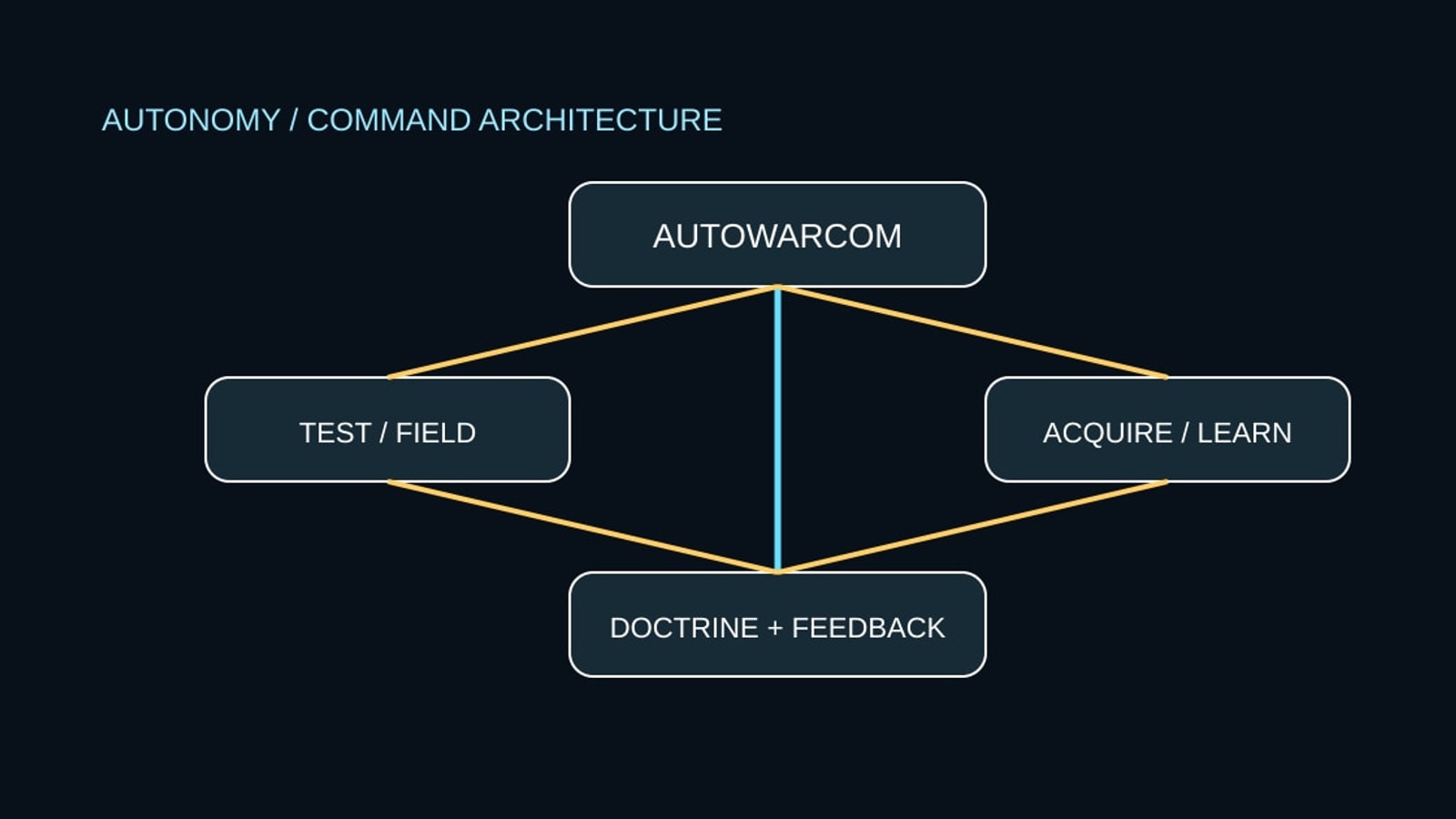
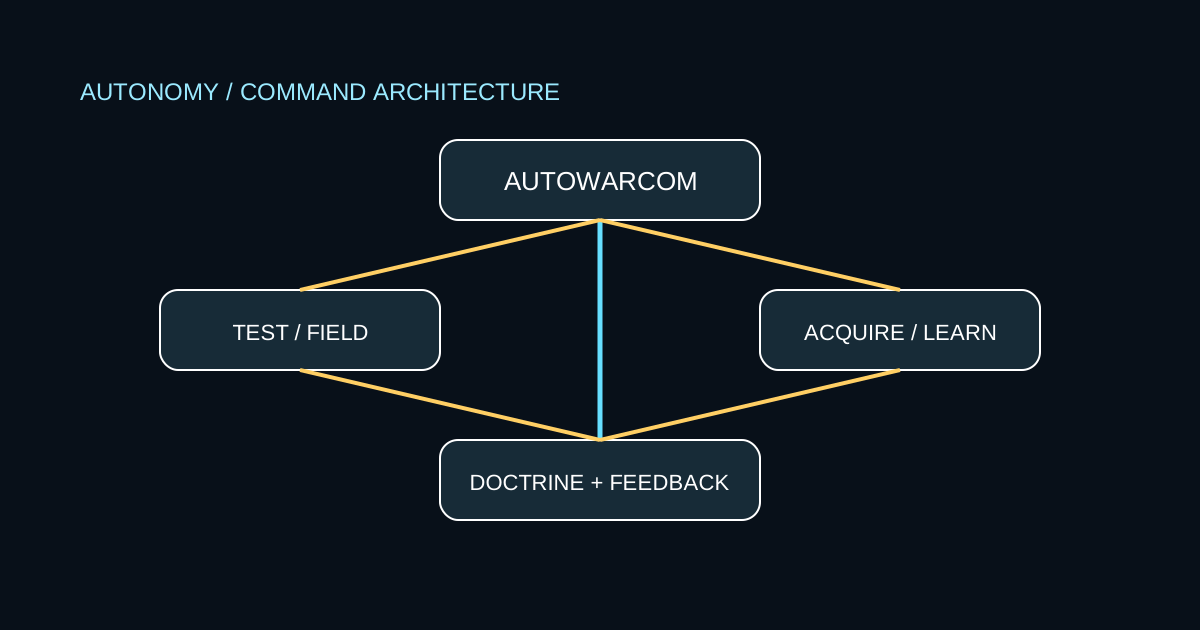
Defense Secretary Pete Hegseth announced plans for an Autonomous Warfare Command, or AUTOWARCOM, during a State of the Force address at Marine Corps Base Quantico. Multiple contemporaneous reports quote him describing it as a four-star combatant command with service-like authorities intended to scale autonomous and robotic capabilities across the joint force.
The command is planned, not fully stood up. Reporting on a memo issued with the announcement says the target is October 1, 2027 and that implementation requires work with Congress.
The command structure is the technology story
Robotics programs can die without a technical failure. They can be trapped between procurement offices, service requirements, budget cycles, testing regimes and commanders who have no durable organization responsible for integrating them.
A dedicated command attempts to change that institutional topology. Reporting describes directed manpower, budget and acquisition authorities as well as dedicated career pathways. If implemented as described, autonomy stops being only a collection of programs and becomes an organizational constituency with people, money and command responsibility.
Service-like authority is not the same as a new military service
The phrase matters because it describes intended powers, not a claim that Congress has created another armed service. Public reporting characterizes AUTOWARCOM as a combatant command with unusual service-like authorities designed to accelerate development and deployment.
The exact boundaries of those authorities, their statutory basis, and how they interact with the Army, Navy, Air Force, Marine Corps, Space Force and existing combatant commands remain implementation questions.
Autonomy has an acquisition-speed problem
Commercial drones, computer vision, autonomy software and electronic countermeasures can change on timelines far shorter than traditional major weapons programs. A platform that is useful when a requirement is written can be obsolete by the time a conventional procurement cycle delivers it.
The announced structure is explicitly framed as an attempt to compress that cycle. The engineering challenge is therefore paired with an institutional one: how do you test, buy, update and sustain systems whose software and countermeasures may change continuously?
Cyberdelia's The Battlefield Is the Training Set examined one side of that loop: operational data can feed model development. AUTOWARCOM would address another side: whether the institution can turn learning into fielded capability quickly enough for the loop to matter.
Authority does not answer the autonomy question
A command can accelerate procurement without resolving where humans must remain in decisions involving force, how systems are tested under degraded communications, what happens when identification confidence is wrong, or how responsibility is assigned when software behaves unexpectedly.
Those are policy, legal, operational and engineering questions, and the public announcement does not settle them.
Nor does a new command guarantee successful technology. Dedicated organizations can concentrate expertise and accountability; they can also create another bureaucracy. The evidence will be in fielding time, test rigor, software-update cadence, interoperability, unit adoption and operational reliability.
The measurable change begins before the first new robot
The immediate significance of AUTOWARCOM is organizational. The Pentagon is signaling that autonomous and robotic systems are important enough to justify a four-star command structure rather than remaining scattered experiments.
That is not proof of a battlefield revolution. It is evidence that the bureaucracy is being redesigned around the expectation of one.
AUTOWARCOM has been announced and a target structure reported, but it is not yet a fully operational command. Congressional action and implementation details remain material dependencies. Analysis here does not assess the merits of the administration or its broader defense agenda.