

Launching a satellite and operating a satellite are not the same event. Between deployment and useful service sits commissioning: the sequence of checkouts, configuration and subsystem activation that proves the spacecraft is actually alive.
The mechanism
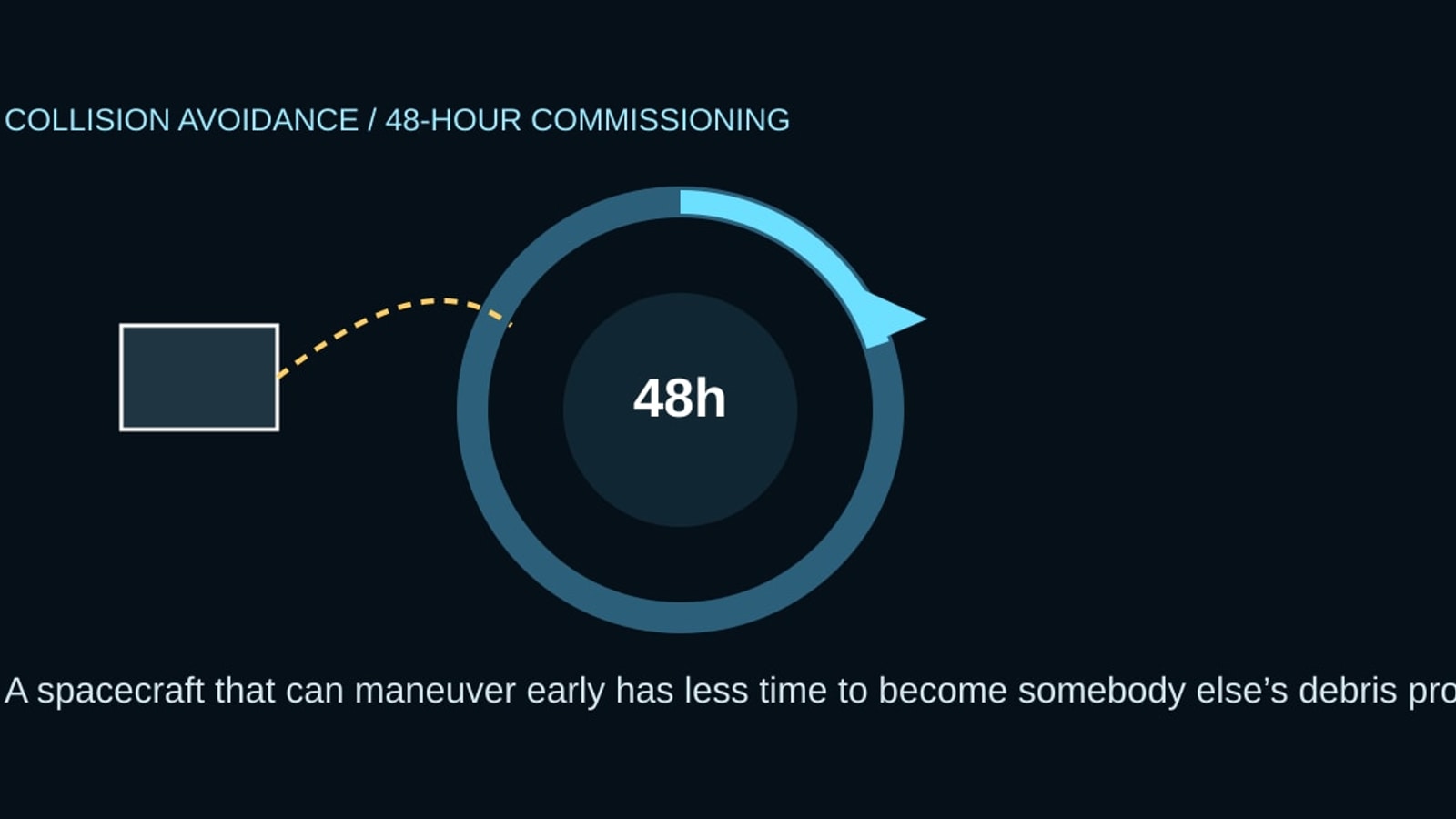
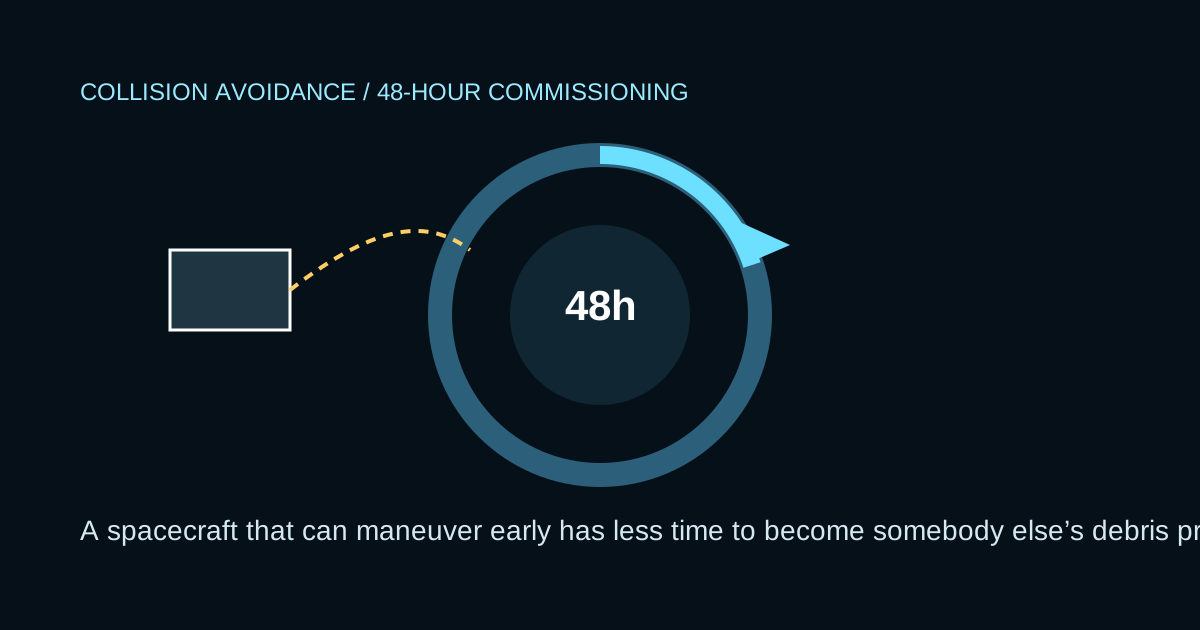
ESA’s GOMX-5 CubeSat launched October 1 on Transporter-18 with an unusually operational target. Its team wants the spacecraft’s propulsion system commissioned within 48 hours so collision-avoidance capability becomes available almost immediately.
The propulsion system uses iodine electric propulsion. ESA has said the traditional commissioning process can take at least a week and that GOMX-5 uses a largely automated platform procedure to shrink that interval.
That compression matters because low Earth orbit is no longer a quiet place where a newly deployed satellite can spend days behaving like a passive suitcase. Constellations, rideshares and debris have turned the first hours after deployment into part of traffic management.
Why it matters
GOMX-5 also carries technology for maritime awareness, but the collision-avoidance experiment is the sharper systems story. ESA’s newer debris-mitigation rules increasingly assume spacecraft should be able to manage their own orbital risk rather than waiting for operators to finish a leisurely activation checklist.
Automation here is not about replacing a mission controller for style points. It is about reducing the period in which the spacecraft exists in orbit but cannot yet execute the maneuver that might keep it there safely.
Evidence boundary
What remains unknown: launch and deployment do not establish that the 48-hour target will be met, that the iodine thruster will perform as expected in orbit, or that the automated commissioning logic will handle off-nominal conditions without human intervention.
the engineering target is small but consequential. If commissioning becomes fast and repeatable, collision avoidance stops being a capability satellites gain later and starts becoming part of being born into orbit.