

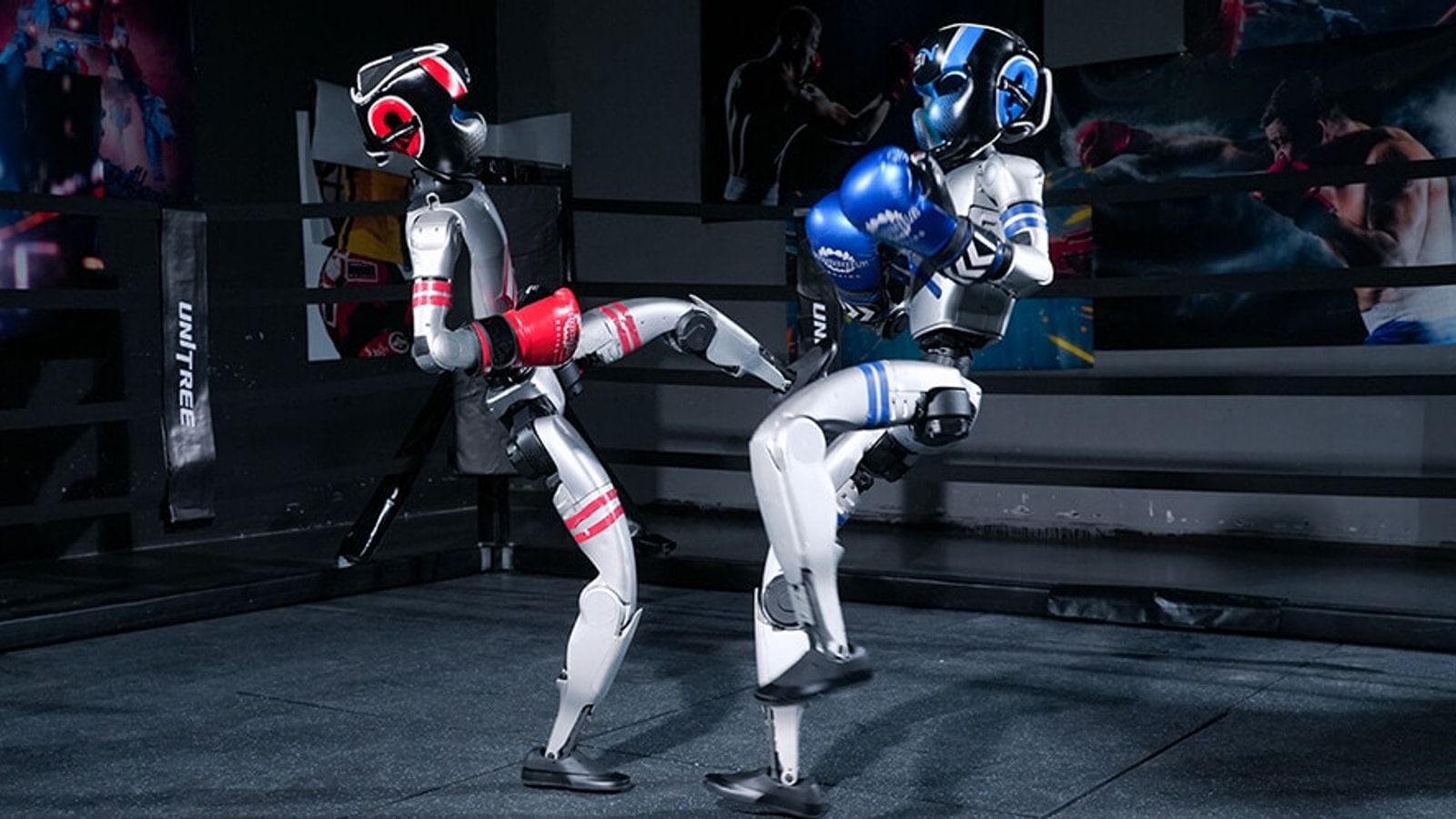
The easiest way to misunderstand teleoperated robot fighting is to call it fake autonomy. It is not autonomy. It is also not fake.
A pilot controlling a humanoid fighter is part of a coupled system. The human sees, predicts, chooses and adapts. The robot stabilizes, constrains, translates and executes. Latency sits between intention and movement. The interface decides how much of the body the operator must consciously control.
Agency can be distributed.
Suppose an operator requests a hook. A high-level interface selects target and timing. The robot's low-level controller handles coordination and balance. A safety layer clips velocity. A recovery controller adjusts foot placement after contact. Who threw the punch? The useful answer is architectural: each layer contributed a different function.
A good interface can create a better fighter without changing the robot.
If a pilot must consciously correct every balance disturbance, tactical attention is consumed by staying upright. Better assistance can move those tasks downward so the human controls intent, timing, target and strategy while the robot handles mechanics.
That is analogous to assistive technology. Maximum automation is not always the goal. Appropriate allocation of control is.
Latency changes the athlete.
A human boxer acts through a nervous system. A robot pilot acts through sensors, networks, software and motors. Delay changes strategy. Camera placement changes spatial judgment. Haptic feedback can restore information video loses. The pilot is learning not only an opponent but an interface.
Autonomy should not erase the human benchmark.
If a robot performs poorly under autonomy but well under skilled teleoperation, the body may be capable while decision software remains weak. If both fail in the same mechanical state, the bottleneck is probably lower in the stack. Human control becomes diagnostic.
Teleoperated robot fighting should be treated as a distinct cybernetic discipline, not a lesser imitation of autonomy. It lets us measure how judgment, interface design, latency and machine stabilization divide responsibility for performance.