

When a measurement does not need an image
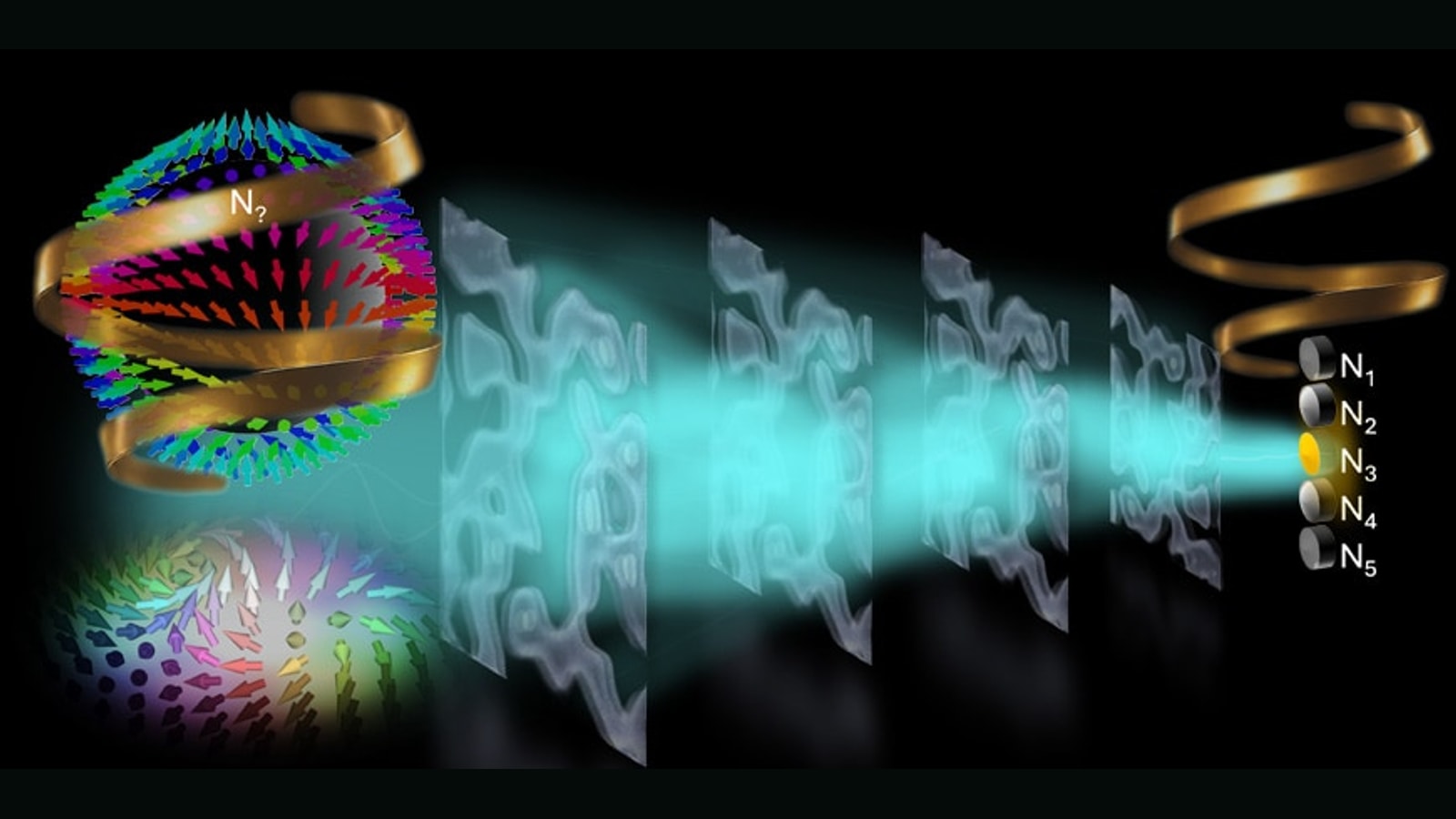
Modern perception often takes an elaborate route to a simple answer. Sensors acquire a large digital record, software reconstructs a signal and a later algorithm calculates the property someone actually wanted. Researchers at the University of the Witwatersrand explored a narrower alternative: let designed optical components help determine the answer before a conventional image is reconstructed. Their peer-reviewed work in Nature Communications on October 7 describes diffractive neural networks for detecting structured-light topologies.
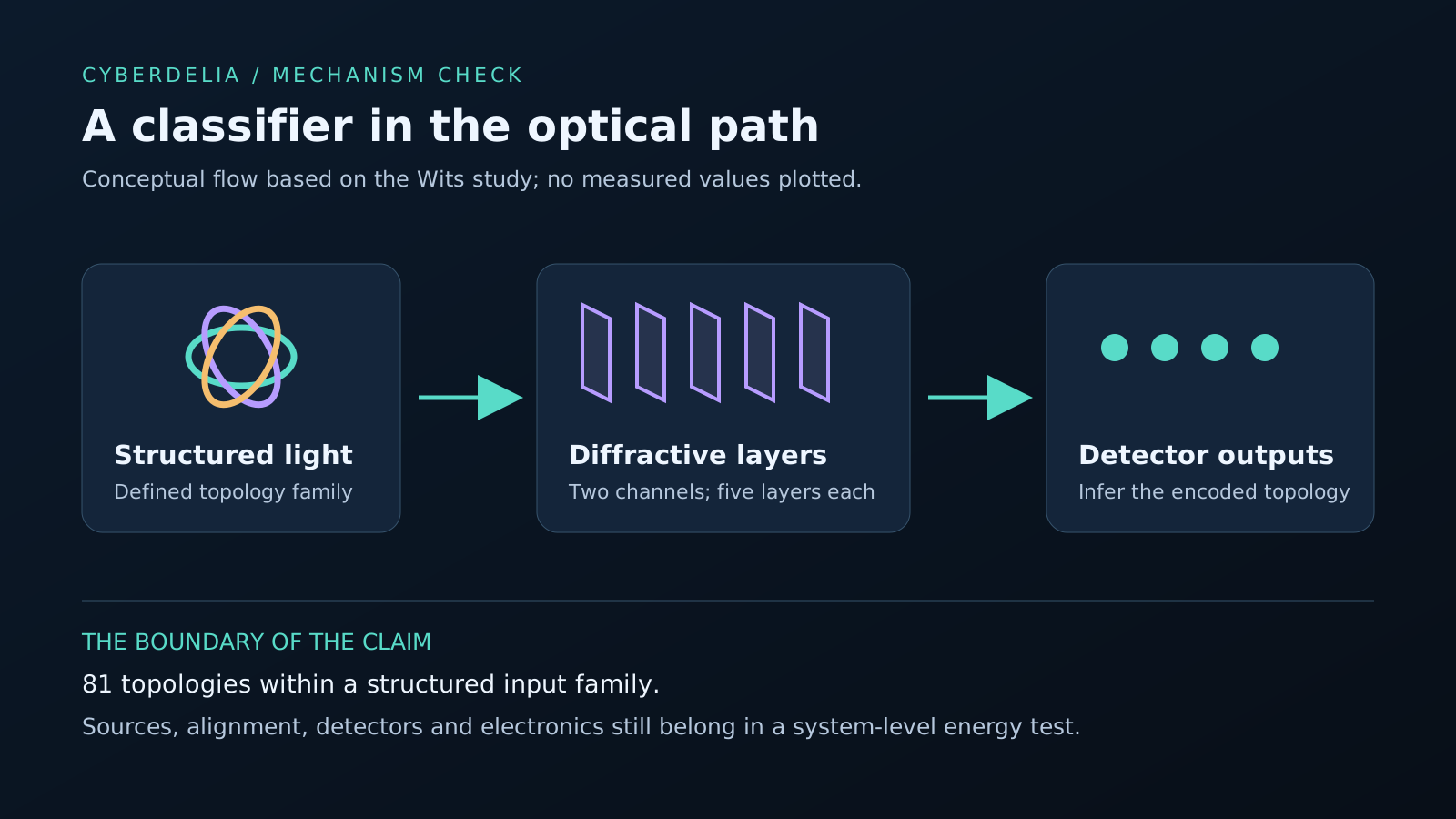
The light passes through multiple designed layers whose interference and diffraction patterns guide energy toward output channels. A detector reads those outputs. The system is specialized: it does not reason about arbitrary objects, understand natural language or operate like a universal computer. It maps a physically defined input family to an output measurement, with a trained optical arrangement carrying part of the work.
What the 81-state experiment actually established
The researchers describe two processing channels with five diffractive layers apiece. They studied 81 topologies constructed from vectorial Laguerre-Gaussian modes, and the university reports recognition after training on fifteen examples. That is an impressive form of generalization within a deliberately structured family. It should not be rewritten as a machine learning to recognize 81 unrelated visual scenes after seeing fifteen pictures. Those are different technical claims.
The paper also reports recognition under noise and the recovery of an image transmitted using a fifteen-level topological alphabet. The latter experiment matters because it tests an encoded communication channel, not only a classifier. Neither result automatically establishes a practical replacement for today's optical links. Commercial relevance would depend on transmission rate, source stability, alignment tolerance, full-system energy, detection error and repeatability across manufactured devices.
Where the proposed advantage could disappear
Optical propagation may perform a task-specific transformation without first converting every relevant detail into digital pixels. But passive diffraction is only one part of a real instrument. Light sources, modulators, detectors, temperature management, calibration and control electronics all carry costs. An honest performance comparison would measure source-to-decision energy at matched accuracy, not just whether the diffractive surface consumes power.
Cyberdelia's first proposed independent test would vary wavelength, alignment, intensity, vibration and temperature while recording classification accuracy. A second would compare an electronic processing system under the same input and precision targets. A third would test reproducibility across separately assembled optical units. The decisive question is whether the architecture works repeatably in an imperfect facility, not whether it succeeds on a carefully aligned optical bench.
The useful distinction
This is not a claim that a beam of light has developed a mind. It is an experimentally grounded demonstration that a specialized mathematical property can be routed into a directly measurable optical signal. The work suggests possible future sensing and communications architectures. Those remain hypotheses for independent testing, not deployed products. South African research earns international attention here through its engineering contribution, not through novelty of location.
SOURCE TRAIL
- Nature Communications, October 7, 2026, primary research paper
- University of the Witwatersrand, October 13, 2026
Known: published laboratory results. Inferred: possible system-level benefits. Unknown: real-world manufacturability and commercial receiver performance. Dated corrections will be added when independent evidence changes these assessments.
CYBERDELIA ASSESSMENT
The study demonstrates specialized optical topology recognition within a defined input family. Any advantage in a deployed receiver still needs matched accuracy, stability and complete-system energy measurements.
METHOD & LIMITATIONS
We read the October 7 Nature Communications paper and the university’s October 13 account. These describe the same research and are not independent replications. Cyberdelia did not run the experiment or measure energy. The proposed tests are our engineering analysis; both images are explicitly labeled illustrations. Sources checked October 19, 2026.
CORRECTIONS & UPDATES
: Repaired page formatting, added the missing publication sections, and replaced placeholder artwork with the university’s credited illustration and a labeled explanatory diagram.
Submit documented corrections through the Corrections Ledger.