

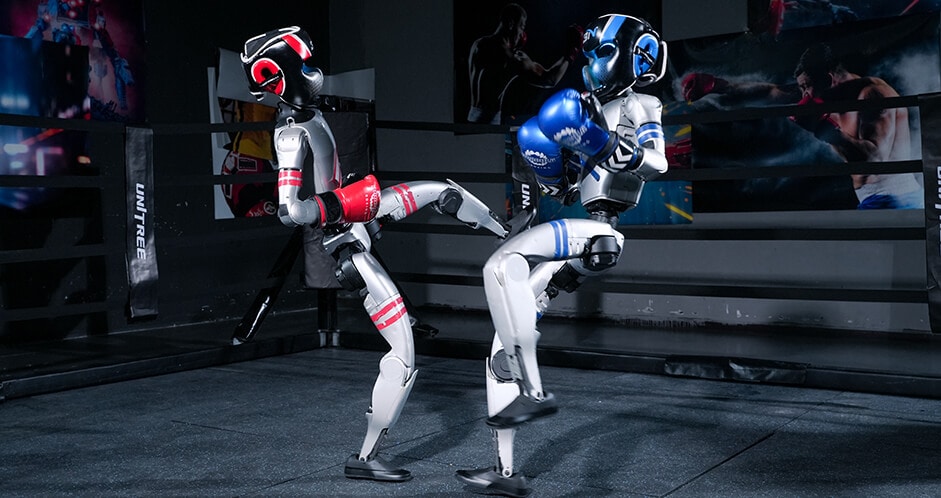
A punch is not an arm event. In human boxing it is a coordinated transfer through the floor, legs, hips, trunk, shoulder and fist. Research on punching biomechanics repeatedly finds the lower body and whole-body kinetic chain matter to strike performance. Humanoid robots make the same fact impossible to ignore.
The punch begins at the floor.
A robot can rotate a shoulder joint quickly and still deliver a poor strike if the rest of the body cannot support the reaction force. Effective impact depends on timing across linked segments, contact geometry, stiffness, foot-ground interaction and what the controller permits the body to do after contact.
This is why “increase arm speed” is not a boxing strategy. The actuator chain has to behave as a body.
Recovery may matter more than peak force.
Maximum impact is attractive because it produces a clean number. Boxing punishes the number if achieving it leaves the fighter exposed. The meaningful metric is force delivered per unit of tactical cost.
Measure post-strike recovery latency: time from meaningful offensive commitment until the robot can again change direction, defend or initiate another valid action. Two robots can land equivalent impacts while one remains vulnerable twice as long.
Traditional advice such as “don't admire your work” is a compact demand to minimize that interval.
Defense is an efficiency problem.
Good defense is not maximum motion. It is enough motion. Large evasive movements can avoid one strike while creating poor position for the next. A small slip, parry or angle change can preserve the ability to counter.
For robots, defensive economy can be quantified through displacement, energy, time and state quality after avoidance. The best defense does not merely prevent contact. It leaves the machine in a better state than the attacker.
Feints are adversarial information.
A feint is a controlled lie. It presents evidence of one action in order to trigger a response that makes another action valuable. Research on combat-sport anticipation shows deceptive cues can alter response and attention.
For an autonomous robot this becomes a fascinating perception problem. If a policy predicts attacks from pre-motion features, an opponent can deliberately manipulate those features. The game moves from action recognition to adversarial action signaling.
A useful feint metric would not be “did the robot twitch?” It would be whether the opponent changed state in a way that improved the feinter's expected outcome.
Rhythm is a hidden variable.
Predictable timing is information. A robot that attacks every 1.2 seconds may look fast until an opponent learns the clock. Human boxers break rhythm by changing pauses, cadence, double actions and entry speed.
Autonomous systems should model timing distributions, not merely average reaction time. Tactical randomness is not noise when it denies prediction.
Ring generalship is constraint engineering.
The sophisticated fighter does not always attack the opponent directly. It changes the opponent's choices. Pressure, angles, feints and foot placement create a sequence in which the eventual strike is the end of a control problem that began several actions earlier.
This is why counting punches alone misses the science. A machine may win an exchange with the step that made the later punch unavoidable.
Robot boxing becomes interesting when strikes stop being isolated motions and become components of an adversarial geometry. Force matters, but so do recovery, defensive economy, deceptive signaling, timing variation and option compression. The punch is the visible output. The sweet science is the system that made it land.
Part 3 of 8 — The Sweet Science