

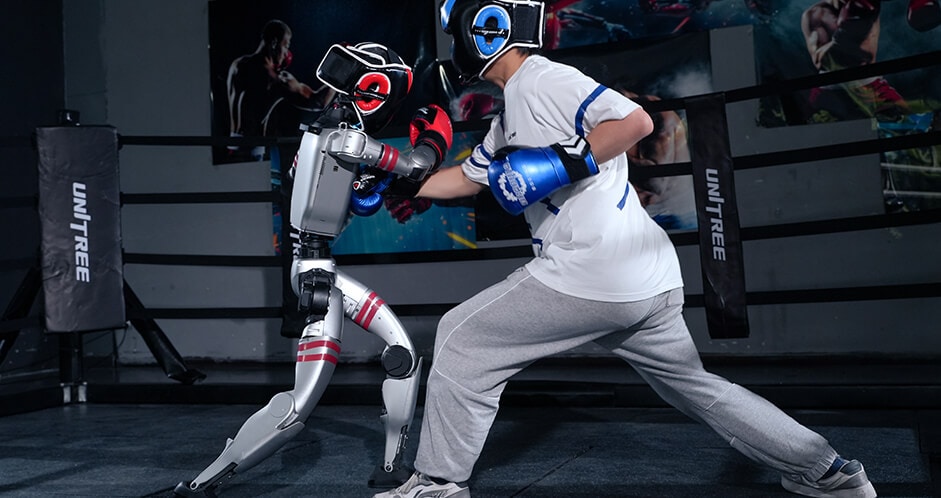
Human conditioning is biological. Robot conditioning is electrical, thermal and mechanical. The analogy is imperfect, but the tactical role is real: a fighter that cannot sustain its performance envelope does not have the same capabilities in the final minute that it had at the opening bell.
Conditioning becomes thermal and energy management.
Repeated explosive actuation draws current, heats motors and electronics and changes battery state. Controllers may derate performance to remain inside safe limits. A robot can therefore have a “gas tank” without lungs.
Style will interact with this constraint. A pressure policy that constantly accelerates may impose a different thermal budget from a counter-fighting policy that waits and bursts. Energy per useful action, not battery percentage alone, should become a tactical statistic.
A robot has no chin. It has failure topology.
Humans have familiar vulnerable targets because biology is shared. Robots will develop vulnerability maps around sensors, joints, structural members, cable paths, protective interfaces and control states.
The meaningful equivalent of punch resistance is not pain tolerance. It is the probability that impact causes loss of useful function. A machine may absorb spectacular cosmetic damage and keep fighting while a small hit in the wrong place produces sensor misalignment or a joint fault.
Rules will determine which vulnerabilities are legitimate sporting targets and which are prohibited equipment attacks.
Teleoperation is its own sport.
Human-controlled robot combat tests latency, interface design, operator perception and machine assistance. Calling it a primitive stage on the road to autonomy misses the point. It is a different competitive architecture.
A talented pilot may read a fight like a boxer while the robot handles stabilization. That combined system can benchmark what the hardware is capable of when tactical reasoning is supplied by a human.
Autonomy changes the question.
Fully autonomous boxing asks whether a machine can infer intent, plan under uncertainty, preserve balance and adapt to an opponent without an external tactician. RoboStriker's hierarchical structure is compelling because it limits high-level exploration to motions the body can actually execute.
Self-play then creates another problem familiar to combat sports: co-evolution. A tactic is only good relative to the field prepared to face it.
Rules are part of the robot.
A competition rulebook changes the optimization target. Points for clean contact, penalties for falls, reset limits, round length, protected zones and repair allowances all alter what behavior is rational.
In reinforcement-learning language, the sport supplies the reward function and constraints. In boxing language, styles evolve around the rules.
Machine styles will emerge.
Some robots will pressure. Some will counter. Some will maximize stability and low-risk scoring. Some will exploit reach. Some will trade durability for speed. Platform-standardized leagues may make these differences especially visible because hardware variation is reduced.
Eventually the word “style” will stop being anthropomorphic decoration and become a statistical description of policy preferences under repeated competition.
The machine fighter will not be a metal copy of a human boxer. Its conditioning, vulnerabilities, control layers and reward structure are different. But those differences do not erase fight strategy. They create new styles around new constraints. The sport begins to mature when we stop asking whether the robot looks human and start asking what kind of fighter its mechanics and policy make possible.
Part 4 of 8 — The Sweet Science