

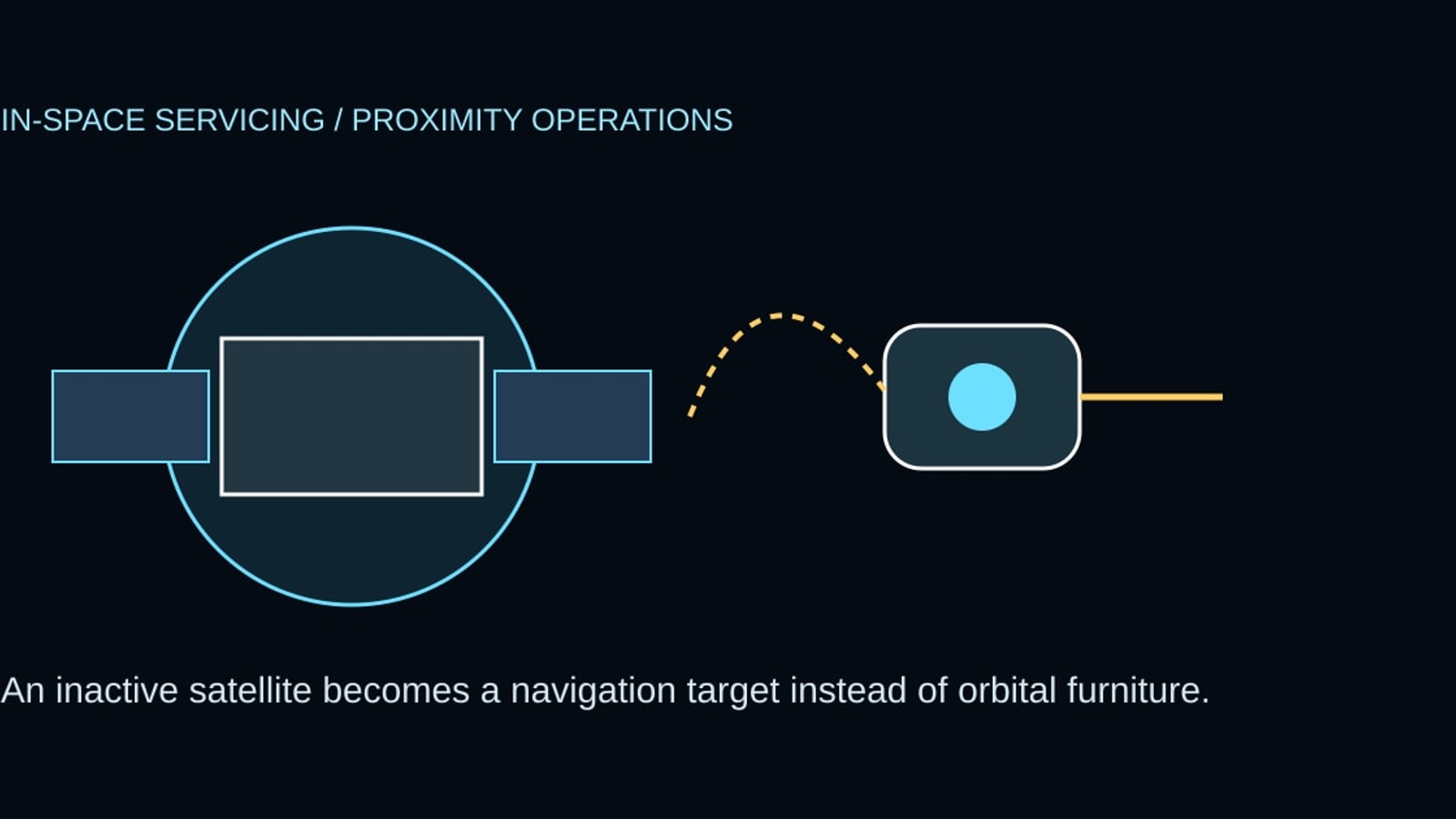
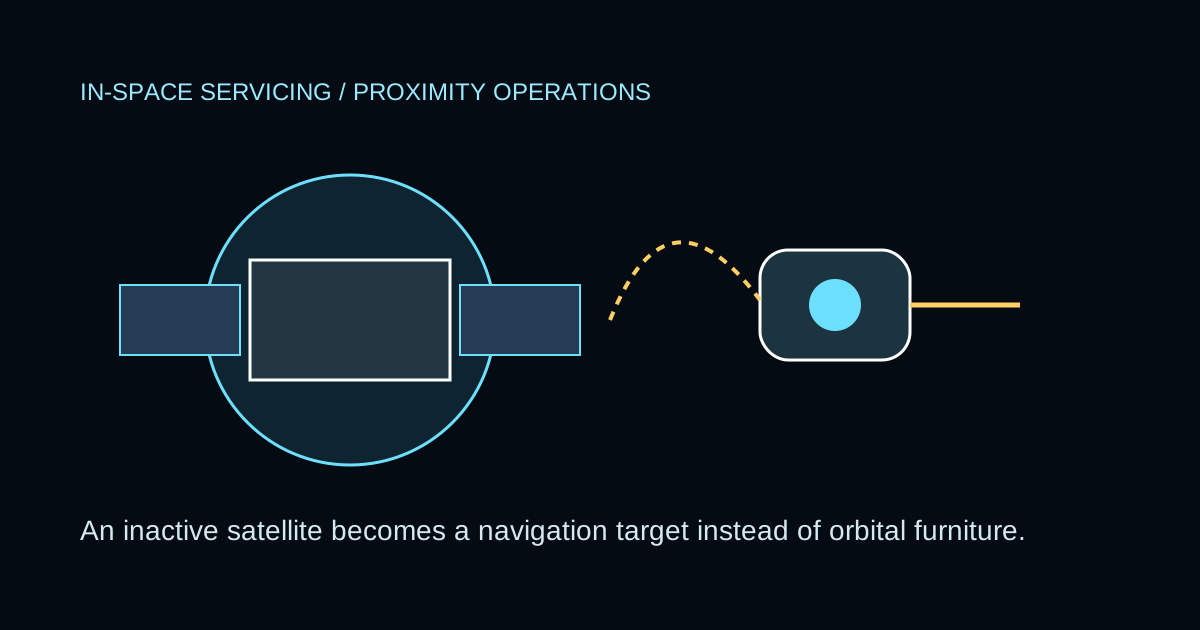
Orbital servicing has a chicken-and-egg problem. Before a spacecraft can repair, refuel, relocate or dispose of another spacecraft, it has to get close without creating a second emergency.
The mechanism
NASA’s Small Spacecraft Propulsion and Inspection Capability mission, or SSPICY, launched on October 1 aboard SpaceX’s Transporter-18 rideshare. The vehicle is Starfish Space’s Otter 24C. NASA says the mission will inspect up to four inoperable U.S.-origin satellites in low Earth orbit.
The interesting part is not a robotic wrench. It is the stack required before the wrench becomes useful: propulsion, autonomous guidance, navigation and control, computer vision, and the ability to characterize a target’s surface, geometry and orbital behavior from close range.
Otter also carries an articulating robotic boom used to direct thrust. Proximity operations are a control problem before they are a mechanical one. A servicing vehicle has to change its own motion while protecting the object it is approaching, often without the cooperative navigation aids a healthy spacecraft would provide.
Why it matters
NASA frames the mission as a technology demonstration for future inspection, servicing and debris assessment. Inspections are expected to begin in 2027, so launch is not the proof point. The proof point is whether the vehicle can approach real inactive spacecraft, gather useful information and leave without making the orbital environment worse.
The broader systems shift is easy to miss. Spacecraft were historically built as isolated missions with little expectation that another machine would visit them after launch. Servicing turns orbit into an operating environment with logistics, inspection and eventually maintenance.
Evidence boundary
What remains unknown: public evidence does not yet establish how closely Otter will approach each target, what inspection resolution will be achieved, or whether the demonstrated techniques will translate cleanly to capture and repair missions.
SSPICY is worth watching because it treats dead satellites as field assets that can be examined rather than anonymous debris. If the inspection loop works, servicing starts with a better map of the problem.