

The future has spent a long time circling the parking lot. Every few years another flying vehicle arrives wrapped in promises about congestion, frictionless commuting, and the imminent disappearance of roads. Then the batteries, weather, operating costs, and landing arrangements enter the conversation. The roads survive.
Jetson’s aerial racing showcase offers a more interesting starting point: people flying actual machines around a course because doing so looks like a hell of a good time. That is a modest proposition compared with replacing urban transportation. It may also be a more productive one.
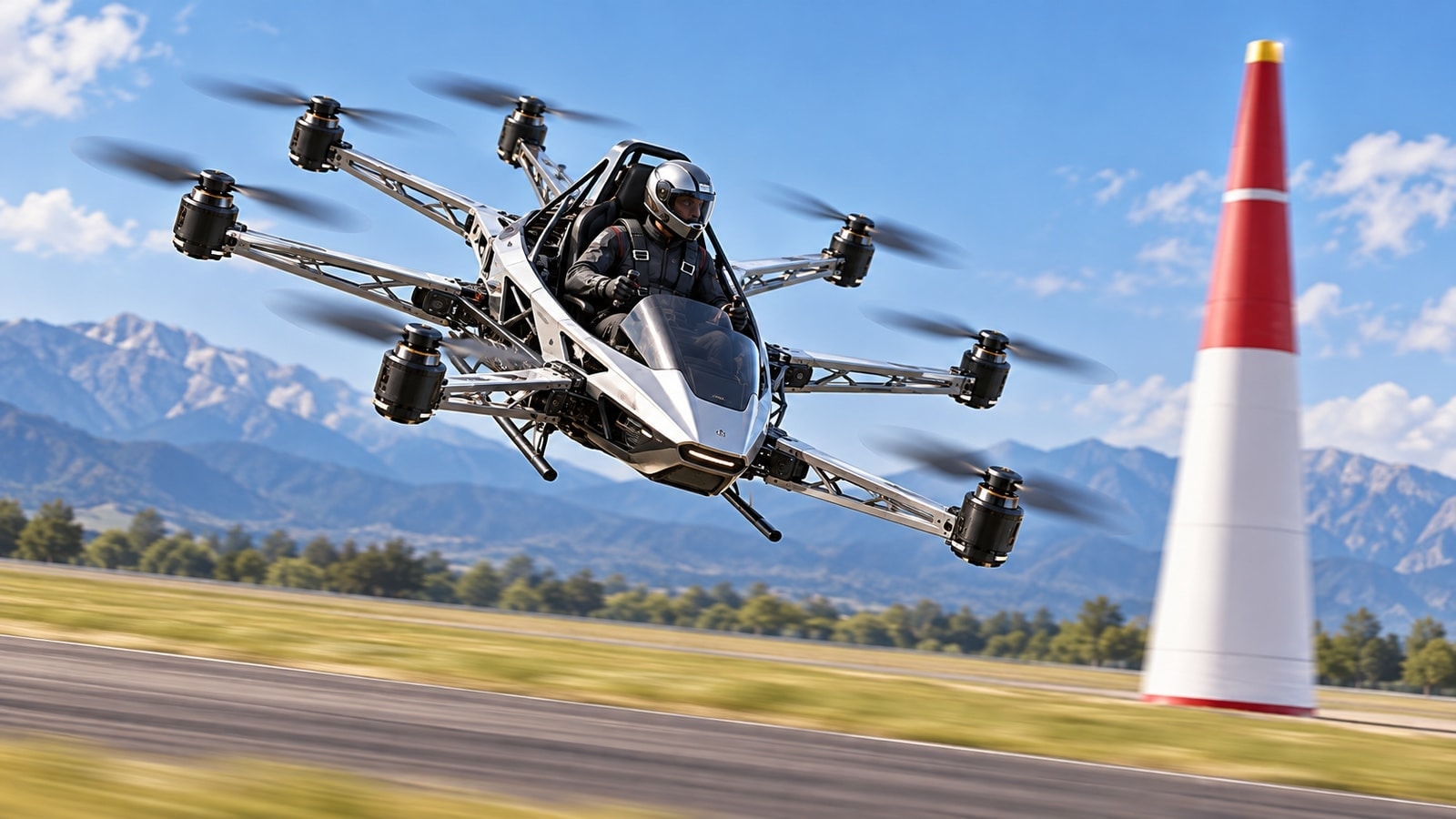
The MSN video circulating under a headline about the first Jetson personal aerial vehicle race traces to the Jetson Air Games concept presented at UP.Summit 2025. Co-founder Tomasz Patan described a four-aircraft formation, a pylon race, and a solo aerial display. This is a look back at that demonstration, rather than news of a race held this week. His account establishes what Jetson showcased; it does not establish an independently adjudicated world-first record across every category of electric air racing. [1]
At Cyberdelia, the spectacle earns our attention. The machine earns our questions.
The Jetson ONE is a single-seat electric vertical-takeoff-and-landing aircraft. Eight electric motors drive eight propellers, and a flight computer assists the pilot. Jetson currently lists approximately 20 minutes of flight time, a software-limited level-flight speed of 63 mph, and a maximum pilot weight of 210 pounds. Those are manufacturer specifications, not performance figures measured by this publication. [2]
They describe a recreational aircraft with a short operating window. Twenty minutes is enough to make a compact flight session plausible; it is not a dispatch plan. A serious operator still needs to know how pilot mass, temperature, battery condition, maneuvering, and reserve policy affect usable time. A published endurance figure cannot answer all those questions at once.
That is where racing becomes interesting. A repeatable course can turn a beautiful flight into a measurable exercise. How consistently does the aircraft respond after several sessions? How much energy does a lap consume? Does control behavior change as the battery depletes? How quickly can a crew inspect the machine and make it ready again? These are questions a development program could answer. The public showcase alone does not answer them.
A leaderboard measures who finished first. Engineering needs the rest of the record: temperatures, power demand, control inputs, maintenance findings, interventions, and aborted runs. If aerial competition develops around this class of aircraft, publishing meaningful reliability data would make it more valuable than a succession of promotional clips. Otherwise, the sport could become an exceptionally photogenic way to conceal the difficult parts.
There is also something culturally useful about admitting recreation as a legitimate purpose. An aircraft does not need to solve every transportation problem to deserve existence. A person wanting to fly through a controlled course is an intelligible customer. The pitch gets weaker when that same experience is stretched into an inevitable future in which everyone flies to work.
The hardware makes that distinction unavoidable. An open cockpit, short endurance, and a one-person payload fit a different mission from dependable transport in varied weather. Nobody should confuse the excitement of a flight demonstration with proof of a complete mobility service. That confusion is where good machinery gets buried beneath bad promises.
Jetson lists a protective spaceframe, redundant battery propulsion, an auto-landing system, a ballistic parachute, and the ability to sustain flight following the loss of one motor. Those features deserve examination as separate protections with separate operating limits. Their presence is not a blanket guarantee covering every failure, altitude, or maneuver. [2]
For a racing format, our questions would extend beyond the aircraft. Where are spectators placed? How is separation maintained? What happens when one pilot slows unexpectedly? Who can stop a session, and what does that command require each pilot to do? A successful demonstration is evidence that a demonstration was completed. Establishing a durable sport requires repeatable procedures and a credible way to handle the flight that does not go to plan.
None of that diminishes the appeal. The attraction is obvious: a compact machine, a human in the loop, immediate movement in three dimensions. There is an honesty to that relationship which a rendering of an imaginary city rarely possesses. Somebody has to assemble it, charge it, inspect it, learn its behavior, and fly it. The future becomes a physical object with fasteners.
The distinction between a recreational aircraft and a commuter also has a regulatory dimension. In the United States, Part 103 defines its ultralight category around single-occupant recreation or sport and specified vehicle limits. It removes particular certification requirements; it does not remove operating rules. Jetson advertises operation without a pilot’s license, but that statement should not be stretched into permission to fly wherever an owner happens to want. [3]
Part 103 prohibits operations over congested areas and open-air assemblies, and requires prior air-traffic-control authorization for specified airspace. Those provisions matter to both a commuting fantasy and a spectator event. The applicable permissions for an actual race must be established for that operation. We have not reviewed the authorizations behind the UP.Summit showcase. An exciting clip cannot establish their scope. [3]
Even setting regulation aside, endurance and range describe different things. As an illustration, multiplying the published 63 mph speed by one-third of an hour gives 21 miles. That is arithmetic using two advertised figures, not a Jetson range measurement. It assumes the maximum listed speed can be sustained for the entire listed endurance, an assumption the product page does not establish. It also spends the entire interval in transit and leaves no separate allowance for reserve or other phases of flight.
That deliberately crude calculation is useful because it exposes how quickly a marketing specification becomes an invented mission. A reader may see speed and time and quietly manufacture a travel radius. A responsible operating estimate needs measured consumption in the intended conditions, the outbound and return legs, and an explicit landing reserve. We do not have the necessary performance curves to produce one here. The honest output of the calculation is therefore a warning about the method, rather than a destination on a map.
Racing presents its own measurement traps. A fast lap after a fresh charge may say little about repeated performance. Suppose two competing programs complete the same number of timed runs, but one cancels additional sessions because its equipment is not ready. A table containing only finished laps would conceal that difference. A development record should count planned attempts, completed attempts, technical withdrawals, and the reasons for intervention. The denominator matters as much as the exciting numerator.
There is a similar distinction between pilot assistance and autonomy. Jetson’s description of its flight computer and emergency functions establishes the assistance the company claims to provide. It does not establish that the aircraft independently understands a course, predicts another pilot’s maneuver, or adjudicates an overtaking conflict. Those capabilities would each need their own evidence. A machine can be easy to control in a normal flight and still require skilled judgment when several aircraft occupy the same small piece of sky.
This creates two plausible directions for the proposed sport. One emphasizes close competition and the drama of simultaneous racing. The other emphasizes individual timed runs, consistent conditions, and comparisons across repeated sessions. Neither format automatically produces better engineering. A time trial can conceal fragile hardware behind frequent replacements; a simultaneous event can generate more theater than usable measurements. The format becomes valuable when organizers explain what they are testing and publish enough information to support the result.
The strongest counterargument to our enthusiasm is that a racing application might optimize the wrong things. Short sessions, tightly managed weather, skilled pilots, and extensive ground support could favor an aircraft that performs beautifully inside a venue but poorly in ordinary ownership. Success in that setting would still be real. Its transfer to a wider market would remain a separate proposition. A racing program should not receive credit for proving reliability in conditions it carefully avoids.
Our assessment would change if repeated operations showed that downtime, battery replacement, maintenance effort, or weather cancellations made even the bounded recreational mission impractical. It would strengthen if a transparent record showed predictable performance, manageable support demands, and conservative recovery procedures across a useful operating season. Those are proposed tests of the thesis, not claims about Jetson’s current fleet.
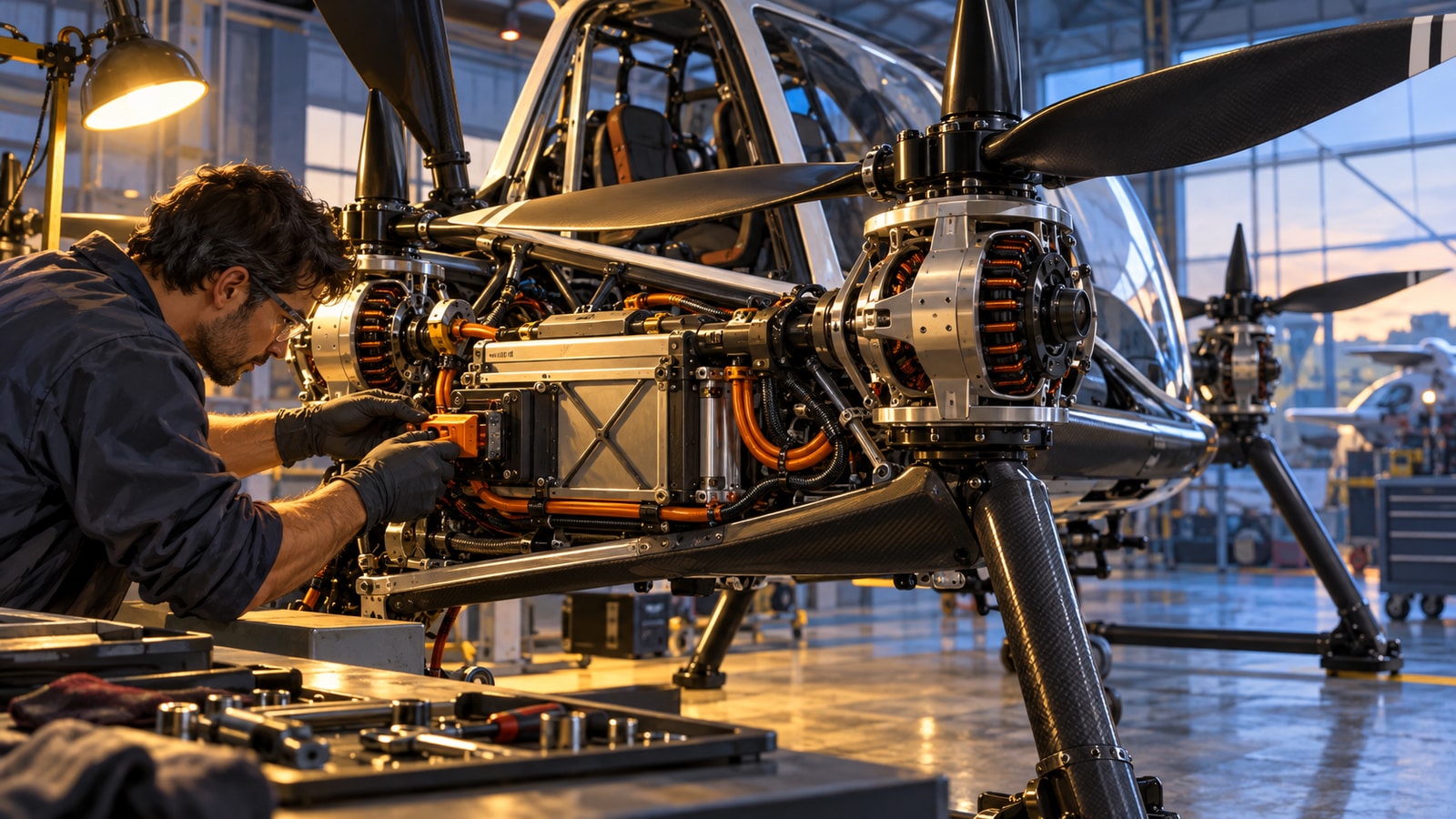
For readers who build and repair things, that distinction is the reward for looking past the cartoon comparison. The aircraft is part of a system whose other components include charging, transport, trained people, spare parts, and the venue itself. The cheapest-looking shortcut in one component may move cost into another. The most impressive craft in a video is not necessarily the most dependable machine on a Saturday afternoon. That second question is less glamorous, and far more revealing.
Our view is that a bounded recreational setting could provide a useful proving ground for personal electric flight. That is an engineering judgment, not evidence that racing will inevitably produce mass adoption. A controlled venue narrows the mission and makes comparison easier. It gives developers somewhere to learn before asking the aircraft to perform an entirely different job.
It also gives the public something better than another countdown to the flying-car age. It gives us a machine doing a specific thing. We can enjoy the thing and still demand the data.
The Jetson showcase deserves coverage because it makes personal electric aviation tangible. What comes next will be decided by the unglamorous work between flights: inspection, maintenance, operating discipline, and improvements that hold up across repeated use. The pylons provide the theater. The workshop determines whether the show gets another season.
And for a publication called Skunkworks, the workshop is where the story starts getting good.
Read the companion feature: The Modern Dirigible: A Flying Machine That Knows How to Stay.
CYBERDELIA ASSESSMENT
A bounded recreational setting could be a useful proving ground for personal electric flight. That thesis depends on repeatable operations and disclosed reliability data, not the spectacle alone.
SOURCE TRAIL
- Tomasz Patan: Jetson Air Games at UP.Summit 2025 — primary source, consulted October 10, 2026.
- Jetson ONE: manufacturer specifications and safety descriptions — primary source, consulted October 10, 2026.
- 14 CFR Part 103: ultralight vehicle applicability and operating rules — primary source, consulted October 10, 2026.
METHOD & LIMITATIONS
This feature compares the co-founder’s event account, manufacturer specifications, and U.S. ultralight operating rules. The MSN page could not be retrieved. Cyberdelia did not attend the event, inspect its authorizations, independently test the aircraft, or establish a universal world-first record. The 21-mile example is a calculation from advertised figures, not measured range. Artwork is AI-assisted conceptual illustration and does not document a real flight or build. Publication date: October 10, 2026.
CORRECTIONS
Submit documented corrections through the Corrections Ledger. Material updates will be dated and explained.