

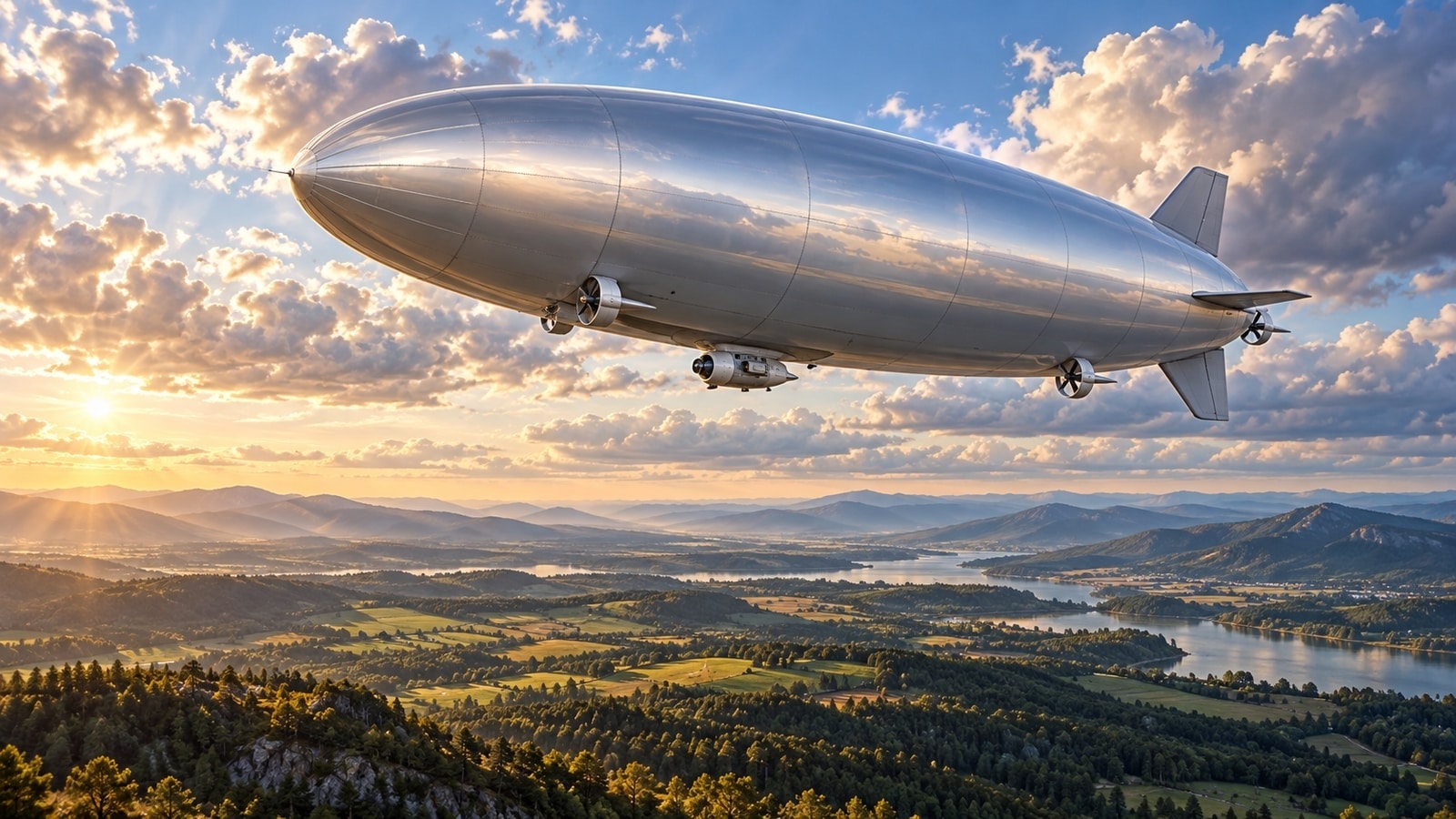
Jetson’s racing aircraft makes the sky look like a place to accelerate. A dirigible asks a different question: what if the useful achievement is staying there?
That question deserves more attention than its antique associations usually permit. The word summons silver giants, ocean crossings, and sepia photographs. But a steerable lighter-than-air aircraft is an engineering architecture, not a historical costume. Its relevance depends on the job it can perform and the compromises that job can tolerate.
A rotorcraft uses powered airflow to support its weight. An airship obtains some or all of its support from buoyancy: its lifting gas and structure displace heavier surrounding air. Propulsion can then be devoted primarily to movement and control, although particular designs also use thrust or aerodynamic lift to supplement buoyancy. That difference makes an airship worth investigating when a mission values endurance over speed. It does not make powered flight free.
The attractive modern version would pair a well-designed helium envelope with lightweight propulsion, modest electronics, and a clearly bounded task. Environmental measurements, inspection imagery, or a mobile communications experiment are plausible subjects for evaluation. The aircraft would need to demonstrate that it can carry the required equipment, produce useful data, and return reliably. A mission statement is not a payload test.
There is serious engineering work behind this territory. Hybrid Air Vehicles describes Airlander 10 as combining buoyant lift, aerodynamic lift, and vectored thrust. Its published commercial vision includes substantial payload and endurance, with future electric propulsion configurations. Those specifications and development plans are manufacturer claims and targets, not evidence that the projected commercial service is already operating. [1]
At the smaller end, researchers have studied modular indoor airships with configurable hardware and software, evaluating how envelope shapes and propulsion arrangements affect behavior. A 2021 paper by Zhaoliang Zheng and colleagues presents precisely that kind of design and evaluation framework. Its relevance is the method: define the parameters, build an aircraft that can be compared with alternatives, and measure the result. Indoor research does not by itself validate outdoor operation. [2]
For a Skunkworks project, that smaller scale is especially interesting. Before imagining a cabin suspended beneath a grand silver hull, imagine an uncrewed demonstrator carrying a sensor package in a controlled space. Give it one task. Measure how well it performs. A small aircraft that reliably answers a narrow question is a better foundation than a magnificent drawing with nowhere to sleep.
The first governing document would be a mass budget. The envelope, propulsion, batteries, mounts, electronics, wiring, payload, and every small attachment compete for the same available lift. Roughly speaking, under standard sea-level conditions, a cubic meter of helium provides about a kilogram of gross lifting capacity after accounting for the helium’s own mass. That is an approximate buoyancy calculation, not a usable payload allowance: the aircraft itself must still be carried, and real atmospheric conditions change the result.
This is why the battery deserves suspicion. More battery can provide more stored energy, but it also adds weight. The design must evaluate that trade rather than assume endurance rises in direct proportion to battery capacity. Every attractive addition needs the same interrogation. A larger camera, a more powerful computer, or another motor has to earn its ride.
Envelope design is equally consequential. A gas-tight shape must retain helium, tolerate handling, carry its intended loads, and survive its operating environment. Seams, attachments, material degradation, and repairability matter as much as the silhouette. A successful concept drawing tells us almost nothing about those properties. A meaningful prototype program would include material and seam testing before relying on the finished envelope.
In conventional nonrigid airship arrangements, internal air compartments called ballonets help manage envelope pressure and can contribute to trim. The FAA’s airship design criteria address pressure systems, loads, controls, and other aspects of airworthiness. They are a useful reminder that the envelope is an aircraft system, not merely a balloon with a gondola attached. The applicable requirements for a proposed vehicle would depend on its actual configuration and operating category. [3]
The largest antagonist, however, is outside the envelope. Wind acts on an airship’s large exposed area. Maintaining a ground position can demand sustained propulsion, and stronger winds can exhaust the available control or energy margin. An endurance claim made in still air is therefore incomplete for an outdoor mission. The useful question is how long the aircraft can perform its task within a defined weather envelope and still be recovered.
Solar power belongs in that same calculation. A broad upper surface suggests an opportunity to collect energy, but panels, mounting, wiring, and power electronics add mass. Available sunlight varies, and the propulsion demand required to resist wind may dominate the balance. Solar assistance is a design possibility to quantify. Painting the word “solar” on a rendering does not close the energy budget.
Ground handling is another place where the romance meets the invoice. Where does the aircraft remain between missions? How is it restrained? What is the recovery procedure when the weather changes? Can its crew handle it without damaging the envelope or exposing themselves to moving machinery? A vehicle that flies beautifully but cannot be managed affordably on the ground may have solved only half its problem.
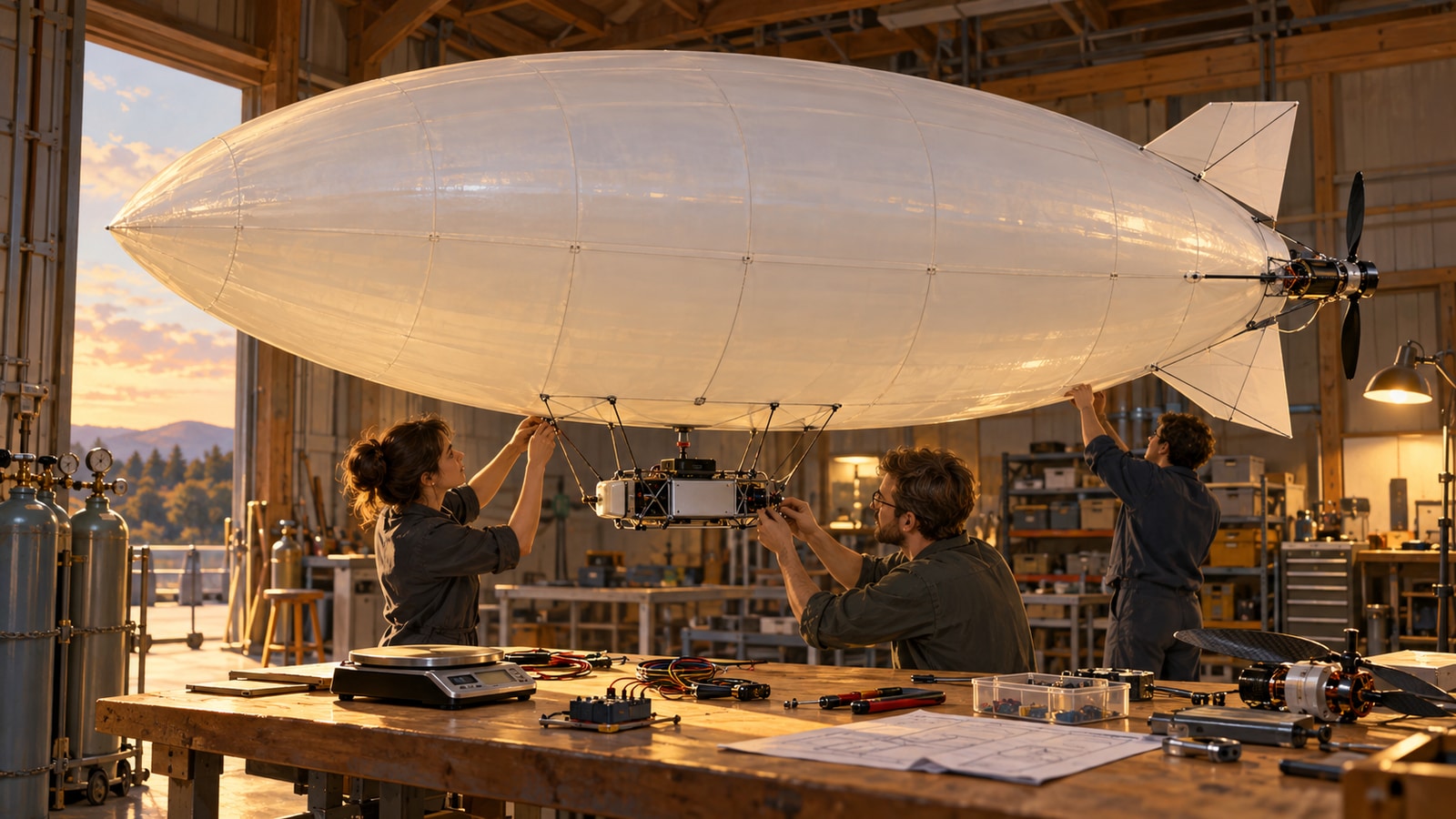
The category needs a little precision. A dirigible is a steerable airship; it need not be a giant rigid Zeppelin. A nonrigid design relies on its pressurized envelope for shape, while a rigid design uses a supporting framework around lifting-gas cells. Semi-rigid arrangements combine an envelope with structural support. The correct architecture for a demonstrator follows its loads, handling requirements, and manufacturing capabilities. Choosing the most dramatic historical silhouette first would reverse that process.
Consider an explicitly illustrative lift calculation. Assume surrounding air density of 1.225 kilograms per cubic meter and helium density of 0.169 kilograms per cubic meter, representative values near standard sea-level conditions. Their difference is 1.056 kilograms per cubic meter. A ten-cubic-meter envelope would therefore provide approximately 10.56 kilograms of gross lifting capacity, expressed as supported mass. If the complete envelope, structure, propulsion, batteries, and controls totaled eight kilograms, roughly 2.56 kilograms would remain before allowances. These are assumed inputs for an example, not measurements of a Cyberdelia aircraft.
The exercise identifies the design question: how much of the buoyancy survives the construction? It also exposes why payload should be specified before shape. A lighter sensor could reduce the necessary envelope volume. A heavy mount could consume the benefit of a more efficient instrument. A designer would need to repeat the calculation using actual gas conditions and measured component masses, while allowing for systems not yet built. The first useful prototype drawing might be a spreadsheet with a particularly unforgiving final row.
Wind creates a second calculation worth keeping beside it. In a simplified model, aerodynamic drag equals one-half the air density multiplied by a drag coefficient, reference area, and relative airspeed squared. Holding shape and those other terms fixed, doubling relative airspeed makes drag four times as large. The mechanical power needed to oppose that drag at the doubled speed rises by a factor of eight. [4] That comparison excludes changing propeller efficiency and other real-world effects; it describes why a calm-weather result cannot simply be carried into stronger winds.
It also complicates the choice between mobility and persistence. If the job is to keep an instrument above one location, a tethered aerostat could deserve comparison with a free-flying airship. A tether brings its own loads, deployment constraints, and regulatory questions, but it may remove the need to use propulsion continuously for station-keeping. If the job requires following a route, the steerable aircraft has a clearer reason to exist. The mission should decide between them before a builder becomes emotionally attached to the propellers.
A convincing experiment would compare useful output rather than airborne duration alone. How many acceptable images or measurements were collected? How much energy and crew time did the session require? How much helium was lost between sessions? What proportion of planned operations occurred within the chosen weather limits? A craft that remains aloft for hours while delivering unusable data has won a stopwatch contest. It has not yet completed a practical mission.
The strongest reason to abandon a small-airship project would be evidence that a simpler platform performs the intended task with less total effort. A ground camera, fixed mast, tethered balloon, or conventional drone might win that comparison. A laboratory should be willing to discover this before investing in the full aircraft. Conversely, a measured combination of gentle movement, useful endurance, and recoverable operations could justify further development. The interesting result is whatever survives the comparison, even if it sends the original sketch back into the drawer.
Our proposed direction would be deliberately modest: a small helium demonstrator, an instrumented test environment, and a payload light enough to leave room for learning. The early objective would be to establish actual mass, leakage, control response, power consumption, and recovery behavior. Outdoor testing would be a separate step, with its own operating limits and regulatory review. Human-carrying flight would be a different project entirely.
The appeal goes beyond endurance. Such a machine could make the engineering visible. Readers could follow measured results, revised components, and the decisions that keep a design honest. The interesting narrative would include the idea that failed, the bracket that weighed too much, and the test that sent the team back to the bench. That is what a laboratory can contribute to a publication: evidence with fingerprints on it.
Cyberdelia has not announced a completed airship or an active flight program. But the question is beginning to sound less like nostalgia and more like something that deserves a mass budget.
There may be room in the workshop for a machine whose ambition is to move slowly, carry something useful, and stay aloft long enough to make the effort worthwhile.
For now, call this an editorial interest. If a helium envelope eventually appears above a Skunkworks bench, you will know which question got out of hand.
Read the companion feature: The Jetson Race Is Real. The Interesting Part Is What Comes After the Applause..
CYBERDELIA ASSESSMENT
A small uncrewed demonstrator is worth evaluating if a defined mission favors buoyancy. Its merits would have to survive measured mass, energy, weather, and recovery constraints—and comparison with simpler platforms.
SOURCE TRAIL
- Hybrid Air Vehicles: Airlander 10 development claims — primary source, consulted October 10, 2026.
- Zheng et al.: User Based Design and Evaluation Pipeline for Indoor Airships (2021) — primary source, consulted October 10, 2026.
- FAA: Airship Design Criteria — primary source, consulted October 10, 2026.
- NASA Glenn: Drag Equation — primary source, consulted October 10, 2026.
- Hybrid Air Vehicles: airship technology and ballonets — primary source, consulted October 10, 2026.
METHOD & LIMITATIONS
This feature synthesizes manufacturer development material, an indoor-airship research paper, FAA design criteria, and NASA’s drag equation. Buoyancy examples use assumed densities of 1.225 kg/m³ for air and 0.169 kg/m³ for helium; they are not measured payload ratings. The wind comparison holds density, reference area, and drag coefficient fixed, using D ∝ V² and mechanical power P = DV. Cyberdelia has not built or flight-tested an airship. The proposed demonstrator is an editorial interest, not an active construction announcement. Artwork is AI-assisted conceptual illustration and does not document a real flight or build. Publication date: October 10, 2026.
CORRECTIONS
Submit documented corrections through the Corrections Ledger. Material updates will be dated and explained.