

Most robot propulsion problems begin with motors, gears, hydraulics or pneumatics. MIT’s latest swimmer begins with a sheet of living skeletal muscle.
The mechanism
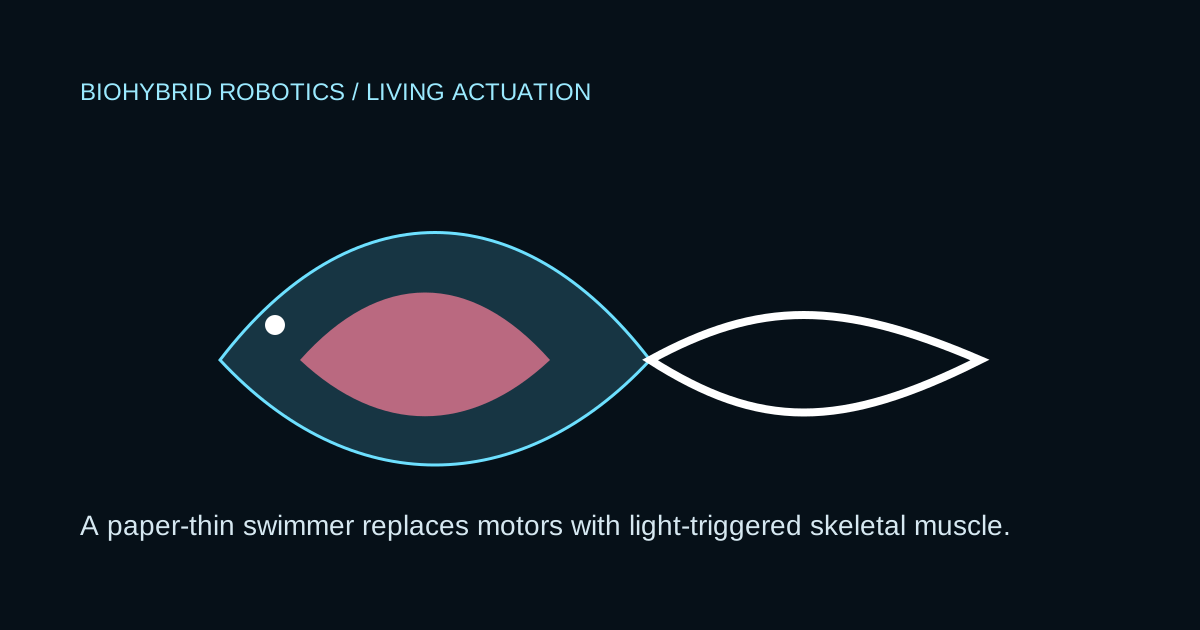
The aquabot is built on a gel film roughly the footprint of a stick of gum. Its two halves act as fins. Each fin carries a layer of genetically engineered muscle cells that contract when illuminated.
Light on one side makes that fin flap. Changing which side receives light changes direction, and changing the timing changes speed. MIT researchers demonstrated the device swimming and turning through a simple watery maze.
The engineering work was not simply attaching cells to a flexible sheet. The team tuned the gel’s material, stiffness, thickness and groove geometry so cells aligned into stronger muscle fibers instead of pulling against one another or peeling away from the substrate.
Why it matters
The finished robot is slow by conventional standards, moving about four body lengths per minute at its fastest. That limitation is part of the point. Biohybrid machines are not competing with propellers on raw thrust. Their potential advantage is softness, efficiency at small scales and the possibility of self-repairing or biologically compatible actuation.
Living actuators also introduce a completely different maintenance stack. Cells need an environment in which they stay viable. Control depends on biology as well as electronics. Manufacturing becomes tissue engineering.
Evidence boundary
What remains unknown: the demonstration does not establish long-duration operation outside laboratory conditions, useful payload capacity, autonomous control, or whether the muscle tissue can remain healthy through repeated field use.
the aquabot matters because it forces robotics to account for a new category of component. A muscle cell is not merely a softer motor. It changes what the machine needs in order to remain a machine.