

Computing heat is usually discussed as a materials problem, a cooling problem or a transistor problem. A Stanford–SLAC experiment points at another lever: the shape of the control signal itself.
The mechanism
The team built a model electrical system from liquid crystals, whose molecular orientation changes with applied voltage. By combining precise electrical measurements with optical imaging, the researchers tracked how energy moved through the system and how much was dissipated.
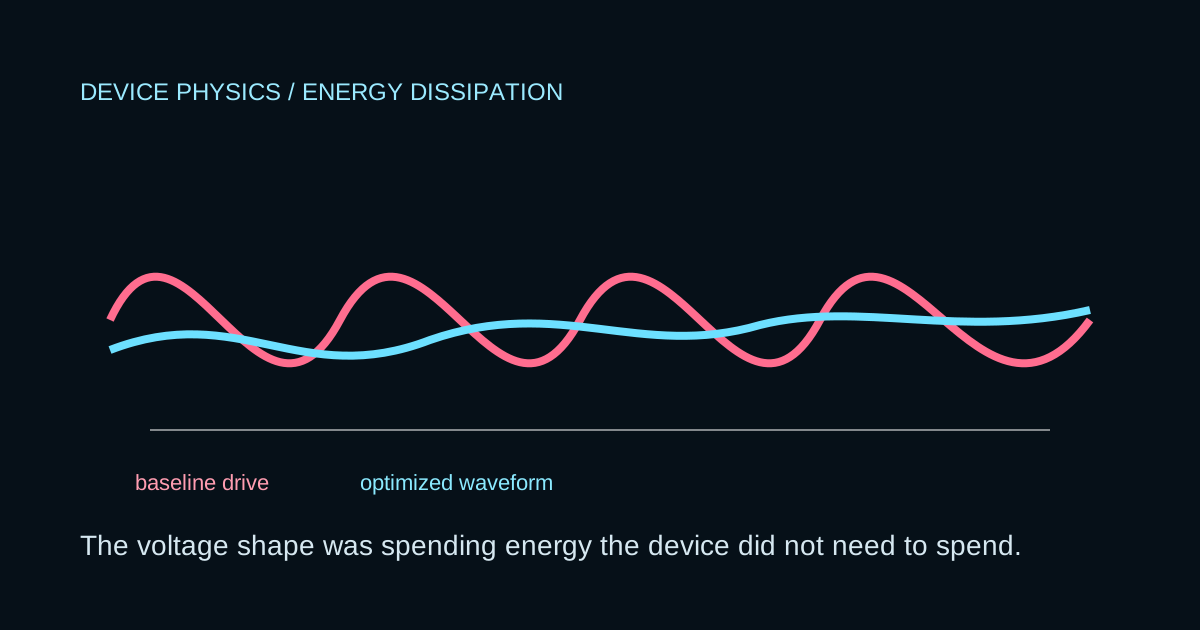
They then used machine learning to optimize the voltage pattern. A drive sequence that rose quickly, slowed for a fraction of a second and accelerated again reduced wasted energy by more than 60 percent in the model system.
The result does not mean existing CPUs can receive a firmware patch and instantly run 60 percent cooler. Liquid crystals are not processors. The point is methodological: if dissipation can be measured with enough resolution, the control waveform can become part of the energy-efficiency design space.
Why it matters
The team plans to apply the method to ferroelectric devices that are closer to actual memory and computing hardware. Those experiments will matter more for practical claims.
The deeper engineering lesson is that losses can hide in dynamics. Two operations that begin and end in the same electrical state can burn different amounts of energy depending on the path taken between those states.
Evidence boundary
What remains unknown: the size of any efficiency improvement in real memory or logic devices has not been established, and device-scale gains do not automatically translate into system-scale data-center savings.
the useful idea is not a 60-percent headline. It is that efficiency can live in timing. Once energy loss is observable, the waveform itself becomes something engineers can optimize.