
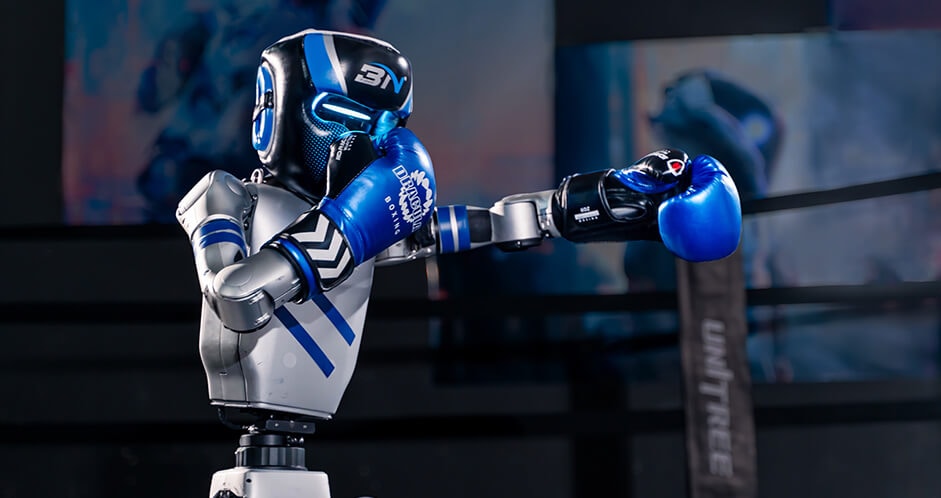
A fighter can be strong, fast and technically elaborate and still be useless if every action leaves the body unable to act again. Boxing learned this brutally early: balance is not one skill among many. It is the condition that keeps every other skill available.
Balance is tactical capital.
A robot begins every exchange with a set of reachable future states. Stable posture, usable foot placement and reserve joint authority give it options. Overcommitment spends those options. A long punch, excessive torso lean or poorly timed step may increase immediate reach while shrinking the set of recoveries available after contact.
Human coaches say “keep your feet under you” because they have learned the same state-space lesson without needing the phrase state space. A fighter who cannot defend, counter, pivot or step after throwing has spent too much capital on the first action.
The support polygon is not the whole story.
Static balance is easy compared with fighting balance. A robot can keep its projected center of mass inside a support polygon and still be tactically compromised. Joint velocity, momentum, actuator saturation and the phase of the gait matter. An opponent does not wait for equilibrium before applying force.
The useful variable is therefore not simply “did it fall?” but “how much recoverable control remained?” That can be measured through disturbance response, time to stable state, available stepping directions and whether a defensive action remained reachable during recovery.
Footwork writes the fight.
Boxing footwork is often misunderstood as graceful movement around the ring. Functionally it manages geometry. Feet establish range, create angles, support force transfer, preserve exits and determine whether the opponent can attack without first solving a positioning problem.
For a humanoid, footwork is tactical locomotion. The robot is not merely navigating to a coordinate. It is choosing a coordinate because that location changes the opponent's action set.
A step outside an opponent's lead side may reduce the line of a direct counter. A lateral step after a combination can move the robot out of the return trajectory. A retreat that remains straight and predictable can let the opponent continue pressure without replanning.
Range is permission.
Distance in boxing is not empty space. It determines which actions are physically available at what cost. Too far out, strikes require reaching or entry. Too close, long weapons lose geometry and short attacks become available. The boundary moves with stance, body angle, reach, step speed and reaction latency.
Robot teams should therefore model effective range, not just arm length. Effective range includes the time and stability cost of entering, striking and recovering. A machine with longer arms but slower recovery can possess less useful range than a shorter machine with better footwork.
Ring position compresses options.
Cutting off the ring is not chasing. Chasing follows the current location. Cutting predicts where the opponent can go and occupies the path that removes choices. In control terms it is action-space compression.
That suggests measurable robot-sport statistics: boundary pressure time, opponent exit directions before and after a step, distance-band control and how often a robot forces a reset without even striking.
The first great robot boxer may not be the machine with the hardest punch. It may be the machine that spends the least balance to create the most tactical pressure. Balance, footwork and range are one system: preserve future actions, alter geometry, and make the opponent pay more than you do for every exchange.
Part 2 of 8 — The Sweet Science